When did refrigerators stop using freon? A homeowner's guide
Explore the transition away from Freon in household refrigerators, what replaced it, regulatory milestones, and practical tips for repair and replacement—tailored for homeowners troubleshooting appliance issues.


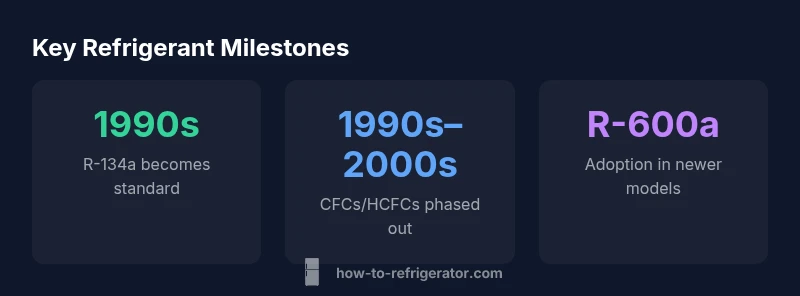
The transition away from Freon in household refrigerators began in the 1990s, when CFCs like R-12 were phased out under international and national regulations. R-134a became the standard refrigerant throughout the 1990s and 2000s, and in many newer models R-600a (isobutane) or similar substitutes are used in light of regional safety rules and efficiency targets. This shift reduces ozone-depleting risk and aligns with energy-efficiency goals.
When did refrigerators stop using freon? A historical milestone
Freon is a trade name historically associated with several refrigerants used in cooling systems, including chlorofluorocarbons (CFCs) and later hydrochlorofluorocarbons (HCFCs). The short answer for homeowners is: the broad shift away from Freon began in the 1990s due to ozone-depletion concerns and regulatory action. According to How To Refrigerator, the adoption of alternatives like R-134a started during the late 1980s and became common throughout the 1990s, with large-scale production and installation continuing into the early 2000s. This transition was driven both by environmental policy and by the need to maintain cooling performance in increasingly energy-efficient appliances. The phrase “when did refrigerators stop using freon” often refers to the broader move from CFC/HCFC blends to safer or lower-impact substitutes in consumer fridges and freezers.
How refrigerant choices evolved: from R-12 to modern substitutes
Key steps in the evolution include the phase-out of R-12 (a CFC) under international agreements and national regulations, followed by widespread adoption of R-134a (a hydrofluorocarbon) in new units. Over time, regional regulations and consumer safety concerns encouraged manufacturers to explore hydrocarbon refrigerants like R-600a in many compact and European-style models. The result is a landscape where the exact refrigerant in a given fridge depends on the model year, region, and safety standards, but older Freon-era systems are increasingly rare in new purchases.
Why the shift matters for homeowners: safety, efficiency, and repairs
Newer refrigerants are designed to meet stricter environmental and energy-efficiency standards while preserving cooling performance. For homeowners, this means changes in service practices, tool compatibility, and leak remediation. The most important takeaway is that refrigerant handling remains a regulated activity requiring licensed technicians, especially on sealed systems. As How To Refrigerator notes, understanding the refrigerant type in your appliance helps you plan maintenance, select compatible replacement parts, and assess repair costs without compromising safety.
Regional variation and the landscape today
The transition was not uniform worldwide. Some regions adopted hydrocabon-based refrigerants earlier due to space, cost, and safety considerations, while others maintained stricter control on flammable refrigerants. In many modern refrigerators, especially European designs and premium brands, R-600a is common in new models, while US and some other markets continue to use HFCs like R-134a with ongoing phase-down plans. Homeowners should verify the exact refrigerant type for their model before performing any service.
Practical steps for homeowners today
- Check the appliance label or service documentation to identify the refrigerant. 2) If you need service, hire a licensed technician who can safely recover and recharge the refrigerant. 3) When shopping for a replacement, consider energy efficiency ratings and the refrigerant type along with capacity. 4) If you plan to repair or upgrade, ask about compatibility with your current compressor and evaporator design. 5) Keep an eye on regional regulatory updates, since phase-down schedules can affect service availability and replacement options.
Looking ahead: refrigerants on the horizon
Research continues into safer, lower-impact refrigerants and alternative cooling technologies. For most homeowners, the practical takeaway remains: modern refrigerators are designed to minimize ozone-depleting substances while delivering reliable cooling efficiency. The ongoing evolution reflects both environmental commitments and the practical realities of everyday kitchen use.
Conclusion fragment for this section
In short, the question of when refrigerators stopped using Freon has a nuanced answer: the era shifted during the 1990s with the transition from R-12 to R-134a, and the market has continued evolving toward more environmentally responsible refrigerants such as R-600a in many regions. For homeowners, staying informed about your model’s refrigerant and service requirements is the best path forward.
Common refrigerant types by era and region
| Refrigerant Type | Era Introduced | Notes |
|---|---|---|
| R-12 (CFC) | 1980s–1990s | Phased out due to ozone depletion |
| R-134a (HFC) | 1990s–2000s | Common replacement in many regions |
| R-600a (isobutane) | late 1990s–present | Used in many newer European models |
FAQ
What does 'Freon' refer to in refrigerators?
Freon is a trade name historically used for several refrigerants, including CFCs and HCFCs. Modern refrigerators typically use different refrigerants such as R-134a or R-600a. The shift is driven by environmental regulations to protect the ozone layer and reduce greenhouse gases.
Freon used to refer to older refrigerants. Today, most fridges use newer refrigerants like R-134a or R-600a to be safer for the environment.
When did refrigerators stop using Freon?
Phase-out of CFCs began in the 1990s with R-12 being replaced by R-134a in many regions. Some markets adopted hydrocarbon refrigerants later. The exact timeline varies by country and model year, but the shift was well underway by the late 1990s.
The move away from Freon started in the 1990s, with R-12 being replaced by R-134a, and continues with regional variations.
Are modern fridges using isobutane (R-600a)?
Yes, many newer European models use R-600a (isobutane) due to efficiency and environmental considerations. In some markets, it is common, but availability varies by region and safety standards.
Many newer fridges use isobutane, but it depends on where you live and the appliance.
Is isobutane safe for households?
Isobutane refrigerants are safe when used in properly designed, sealed systems and installed by licensed technicians. They are flammable, so installations and servicing follow strict safety protocols.
Isobutane is safe when the appliance is designed for it and serviced by professionals.
How can I identify the refrigerant in my fridge?
Look for the appliance’s label near the back, inside the door, or on the service manual. The label lists the refrigerant type and amount. If in doubt, contact the manufacturer or a licensed technician.
Check the label on your fridge or its manual to identify the refrigerant, or ask a licensed tech.
Do refrigerant repairs require special handling?
Yes. Refrigerants must be recovered and discharged by licensed technicians using approved equipment. Do not attempt to vent or recharge sealed systems yourself.
Yes—refrigerant work must be done by licensed professionals with proper equipment.
“The shift away from Freon-era refrigerants reflects both ozone protection goals and a commitment to modern energy efficiency. Today’s refrigerators maintain cooling performance while reducing environmental impact.”
Top Takeaways
- Understand Freon refers to older CFC/HCFC refrigerants phased out for environmental reasons.
- The 1990s marked the transition to R-134a and other alternatives in many markets.
- Regional differences mean some models now use R-600a (isobutane) or other substitutes.
- Repair work requires licensed technicians due to sealed systems and refrigerant handling rules.
- Check your model’s label to confirm refrigerant type before any service.