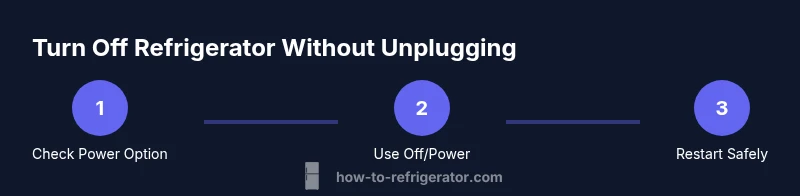
How to Turn Off Refrigerator Without Unplugging
Learn how to safely turn off a refrigerator without unplugging it, using built-in controls or a dedicated power option. Practical steps, safety notes, and troubleshooting tips from How To Refrigerator.


Learn how to safely turn off a refrigerator without unplugging, using built-in controls or a dedicated power option. This guide covers when it's appropriate, step-by-step methods, and safety considerations to protect food and the appliance. Follow model-specific instructions and avoid risky workarounds. Whether you are performing maintenance, defrosting, or troubleshooting, understanding how to turn off refrigerator without unplugging helps you avoid temperature swings and wasted energy while keeping perishable items safe.
How to Turn Off a Refrigerator Without Unplugging: A Practical overview
Knowing how to turn off refrigerator without unplugging is a common request for homeowners who need to perform maintenance, defrost, or troubleshoot without disconnecting the power supply. In many modern models, the control panel includes a Power Off, Off, or Pause option that stops the compressor while keeping the internal electronics powered. According to How To Refrigerator, the most reliable method is to use the model’s built-in settings first, because it minimizes temperature fluctuations and preserves door seals. If your model has no dedicated power-off option, you can use alternate approaches described in this guide. The goal is to avoid unplugging whenever possible while still achieving a safe, controlled shutdown. This approach aligns with best practices for appliance care in 2026 and reflects insights from the How To Refrigerator team.
Before you start: safety and planning
Before attempting to turn off the refrigerator without unplugging, clear the area around the appliance and gather the necessary tools. Ensure you can access the control panel or circuit breaker without stretching or leaning awkwardly. Remove any exposed food from shelves if a premature shutdown could risk spoilage, and plan to move perishable items to a cooler if the off period might be lengthy. Always consult the user manual for your specific model, as features like Power Off, Vacation Mode, or Pause can vary. How To Refrigerator emphasizes model-specific instructions and cautions against improvising settings that could damage the compressor or lead to frozen coils later.
Check for built-in power-off options on your model
The first step in learning how to turn off refrigerator without unplugging is to inspect the control panel for a dedicated Power Off, Off, Pause, or Vacation setting. Some models use a touchscreen to select Off, while others rely on a physical dial or button labeled Power Down. If you locate Off, select it and confirm the change. If your model uses a different label (Pause, Sleep, or Eco), review the impact on cooling cycles. How To Refrigerator analysis shows that most modern refrigerators provide at least one non-destructive way to halt refrigerant compression temporarily, which is safer for food than unplugging abruptly.
Step-by-step: using the control panel to stop cooling
If your model offers an explicit Off setting, use it to stop the compressor and pause cooling. Then, verify the interior temperature stabilizes and the compressor remains inactive. If available, set the thermostat to Off and let the unit settle for a few minutes. Be mindful that some units may keep fans running for air circulation; this is normal and intended to prevent mold growth. Pro tip: take a quick photo of the current display before changing settings to help restore previous configurations later.
When Off isn’t available: using the circuit breaker
If the control panel lacks a power-off option, you can safely cut power using the dedicated circuit breaker for the refrigerator circuit. Switch OFF the fridge breaker, wait 1-2 minutes, then switch it back ON when you’re ready to restart. Do not flip the main house breaker or other circuits, as this could affect other appliances. After the breaker is OFF, keep the doors closed to maintain residual temperature and minimize the risk of spoilage. This method is a widely accepted fallback when model-specific OFF controls are absent.
Food safety and organization during the off period
Turning off the refrigerator without unplugging can affect food safety if perishable items warm beyond safe temperatures. Prioritize moving meat, dairy, and prepared foods to a secondary cooler or another running fridge if a long shutdown is anticipated. Keep doors closed while off, and avoid opening frequently. If you must open, do so quickly to limit temperature rise. When you’re ready to resume cooling, monitor temperature changes and re-close doors promptly to maintain a stable environment.
Restarting cooling safely: what to expect
When you’re ready to resume normal operation, turn the control panel back to the usual cooling setting or turn the circuit breaker back ON. Do not rely on a quick blast of cold air to re-establish temperature; allow the compressor to cycle back gradually. Expect a period of time—often a few hours—before the freezer and fresh-food sections return to their normal temperature. Confirm temperature readings with a thermometer and ensure door seals are intact and clean.
Common mistakes and how to avoid them
Common mistakes include turning off the fridge too frequently, using the wrong control (e.g., unplugging instead of Off), and opening doors during the off period. These mistakes can shorten appliance life, cause food spoilage, or create moisture-related issues. Always refer to your model’s guide before taking action, and use the recommended control or breaker method rather than ad-hoc changes. How To Refrigerator advises homeowners to document steps for future reference and to check for any model-specific cautions.
Tools & Materials
- Fridge control panel with OFF/Power option(Look for OFF, Power Down, Pause, or similar labeling; not all models have a dedicated Off.)
- Dedicated circuit breaker for the refrigerator(Identify the fridge circuit in the main panel and switch OFF, then ON after maintenance.)
- Owner's manual or model-specific guide(Helpful for model-specific power-off or pause features.)
- Notepad and timer(To track duration of the off period and reactivation time.)
- Thermometer or fridge app (optional)(Use to monitor interior temperatures after restart.)
Steps
Estimated time: 15-25 minutes
- 1
Locate power-off option on control panel
Inspect the control panel for an OFF, Power, Pause, or Vacation button. If found, confirm its function from the manual and prepare to engage the setting. This step establishes the primary, non-destructive method to halt cooling without unplugging.
Tip: If you can’t locate a power-off label, proceed to Step 3 to use the breaker method. - 2
Set thermostat to Off or 0
If the panel supports Off or a zero setting, apply that control and listen for the compressor stopping. Wait a few minutes to observe the interior temperature flattening and ensure fans are not actively cooling.
Tip: Take a photo of the current display for reference when reactivating. - 3
Use Pause/Eco mode if available
Some models use Pause, Eco, or Sleep to suspend cooling without a full Off. Select this option and monitor performance. This method is safer for short maintenance tasks and minimizes temperature swings.
Tip: Check the manual to confirm what Pause mode does to airflow and defrost cycles. - 4
Cut power via the refrigerator circuit breaker
If no control panel option exists, switch OFF the fridge’s dedicated breaker in the main panel. Keep doors closed and wait 1-2 minutes before turning power back ON.
Tip: Make sure you flip only the fridge breaker—do not disrupt other circuits. - 5
Confirm the compressor is off
After power-off, listen for the absence of the compressor hum. If you still hear buzzing or rapid cycling, re-check the breaker or panel settings and ensure the door seals are not compromised.
Tip: Avoid opening the door repeatedly during the off period to maintain temperature. - 6
Restart and monitor temperature
When ready, restore power to the fridge and allow time for the temperature to drop back to normal. Monitor shelves for condensation and ensure seals are intact. Typical recovery can take 2-3 hours depending on room temperature and model.
Tip: Use a thermometer to verify internal temperatures after restart.
FAQ
Can I turn off my refrigerator without unplugging it?
Yes, if your model includes an Off or Power setting on the control panel. If not, you can use the dedicated circuit breaker to cut power and restart later. Always follow the model’s manual for exact steps.
Yes—use the control panel’s Off option if available, or the fridge’s circuit breaker to cut power and restart when ready.
Is it safe to turn off a fridge using the circuit breaker?
Yes, when done correctly. Switch only the fridge’s dedicated breaker and keep the doors closed to protect food. Avoid frequent cycling that stresses components.
It’s safe if you switch only the fridge’s breaker and keep doors closed, avoiding repeated power cycling.
Will turning off the fridge affect the freezer?
Turning off the compressor stops cooling. Freezer contents may thaw if the period is long, so plan to keep frozen items cool elsewhere if needed.
Turning off stops cooling; freezer contents may thaw if left off too long, so plan accordingly.
How long can perishables stay safe while the fridge is off?
Avoid relying on a long off period for safety; move perishables to a cooler if you expect the off time to be extended. Monitor the interior temperature once restarted.
Don’t rely on a long off period for safety; move perishables to a cooler and monitor temperature after restarting.
What should I do after turning the fridge back on?
Check door seals, ensure proper airflow, and verify temperatures. Give the unit time to return to normal cooling and avoid excessive door openings during the initial restart.
Check seals, monitor temperatures, and allow time for cooling to resume after restart.
Are there risks to turning off and on frequently?
Frequent cycling can wear the compressor over time. Use the recommended powers-off method only as needed and avoid repeated toggling.
Frequent on-off cycling can wear the compressor; use power-off methods sparingly.
Watch Video
Top Takeaways
- Know your model’s power-off options and use them.
- Prioritize control-panel methods before breakers.
- Protect food by limiting door openings during off periods.
- Restart gradually and monitor temperatures after reactivation.