How to Start a Fridge for the First Time: Step-by-Step Guide
A homeowner-friendly guide to unbox, install, and power up a new refrigerator for the first time, with safety checks, temperature calibration, and early maintenance tips from How To Refrigerator.


You’ll power up a new fridge by placing it in its location, leveling, connecting power, and letting it run empty for 2-4 hours before loading. Ensure the door seals are intact and the fridge has proper air clearance. This guide covers safety checks, temperature calibration, and initial maintenance to prevent cold-chain issues.
Why starting a fridge correctly matters
Starting a fridge correctly matters for safety, energy efficiency, and food safety. When a fridge is not set up properly, it can overwork the compressor, run inefficiently, and fail to reach the correct temperatures, risking spoilage. According to How To Refrigerator, an improper startup can waste energy and shorten the appliance’s life. A correct first startup establishes the cold-chain integrity, protects perishable foods, and reduces frost-related problems later. In this section, we cover location choices, ventilation clearances, and basic physics of heat transfer that influence how quickly your fridge stabilizes. We'll explain the difference between a proper install and a hurried setup, and provide a checklist you can follow even if you’re not a professional. By understanding the fundamentals, homeowners can avoid common mistakes and ensure reliable cooling from day one.
Safety first: unplugging and setup
Before you move or install a fridge, unplug it if it has power. This reduces the risk of shock while handling and helps protect the internal components during placement. When moving the unit, keep it upright to protect the compressor. Wipe away packaging dust and check that the floor is clean and dry to prevent slips. If you’re installing in a damp area or near heat sources, consult the manufacturer’s clearance guidelines and do not overload outlets. The How To Refrigerator team emphasizes safety as the foundation of any reliable startup.
Pre-installation checks
Choose a location that’s in a cool, dry area with steady temperature and good airflow. The fridge should stand at least a few inches from walls on the sides and back to allow air circulation; keep it away from heat sources and direct sunlight. Verify that the outlet is grounded and can handle the load. Inspect the appliance for any shipping damage before plugging in. Read the user manual for model-specific clearance and orientation instructions, and keep a small spirit level handy to confirm levelness. A level fridge prevents doors from binding and ensures even cooling.
Initial power-up sequence
With the fridge in place, plug it into a grounded outlet. Listen for the compressor start; you may hear brief startup noises as the refrigerant circulates. Do not open the doors during the first few hours; each door opening interrupts the cooling cycle and lengthens stabilization time. If the model includes anti-tip brackets or adjustable feet, set them according to the manual and recheck level after installation. Allow the unit to run empty for 2-4 hours before loading perishable foods to let temperatures stabilize.
Temperature setup and calibration
Set the fridge temperature to a starting point around 37-40°F (3-4°C) and the freezer to 0°F (-18°C). After initial power-up, give the appliance 24 hours to settle at these targets; use an accurate thermometer placed inside the compartments to monitor. If readings are consistently off, recheck door seals and air flow. Avoid placing hot foods inside; give them time to cool to room temperature to reduce moisture load and prevent stressing the cooling system.
Food safety considerations for the first run
Do not stock the fridge with dairy, meat, or prepared foods until the interior temperature has stabilized. Start with a few items that are leftovers or beverages to test cooling performance. Use a fridge thermometer to verify interior temps, and avoid overloading shelves; air must circulate. If you notice frost buildup or condensation, check seals and defrost if needed per the manual. Following these steps helps prevent spoilage and keeps food safe from the outset.
Ongoing maintenance after first start
Once stabilized, keep the interior clean and organized to prevent food safety issues. Schedule periodic checks of seals, drip trays, and condenser coils to maintain efficiency. Clean the door gaskets with warm, soapy water and inspect for cracks. Set a reminder to replace water filters if applicable and to tune the temperature settings based on seasonal changes. Regular maintenance reduces energy use and extends the appliance’s life.
Tools & Materials
- Power outlet tester(to confirm grounded outlet)
- Spirit level or smartphone level app(to verify level orientation)
- Measuring tape(to confirm 2-3 inches clearance on sides/back)
- Cleaning cloth and mild detergent(for initial wipe-down and interior cleaning)
- Instruction manual(model-specific guidance)
- Anti-slip mat (optional)(helps prevent movement on slick floors)
Steps
Estimated time: 2-4 hours
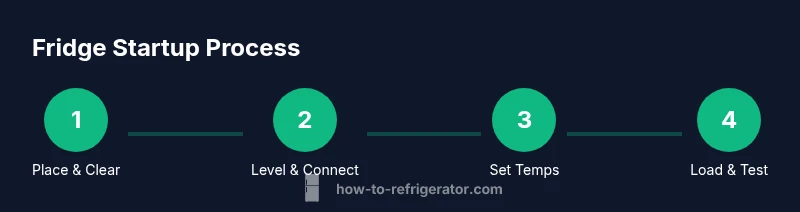
- 1
Choose location and clear area
Select a cool, dry spot with good airflow. Remove packaging debris, and clear a path for access. Use a measuring tape to verify at least 2 inches of clearance on the sides and back for ventilation. Keeping the area dry helps prevent slip hazards and corrosion.
Tip: Pro tip: pre-check the floor level and mark a reference line for later alignment. - 2
Unbox and inspect the fridge
Carefully remove all packaging. Inspect doors, panels, and shelves for damage. Wipe down the interior with a damp cloth to remove any dust or residues from shipping. Confirm that the model’s user manual is present and legible.
Tip: Pro tip: document any shipping damage with photos before power-up. - 3
Level the fridge and position feet
Place the unit, then use a spirit level to check front-to-back and side-to-side levelness. Adjust the feet or casters as needed until level in all directions. Leveling helps doors seal properly and prevents vibration that wastes energy.
Tip: Pro tip: recheck level after you plug in and shift the fridge into final position. - 4
Connect power safely
Plug into a grounded outlet using the recommended cord. Avoid extension cords unless explicitly allowed by the manufacturer. Listen for the compressor start; a short delay is normal as refrigerant begins circulation.
Tip: Pro tip: test the outlet with the tester before powering the fridge for the first time. - 5
Set initial temperatures
Adjust the fridge to about 37-40°F (3-4°C) and the freezer to 0°F (-18°C). Do not overload shelves yet; allow air to circulate. Keep doors closed during the first 24 hours to speed up stabilization.
Tip: Pro tip: place a fridge thermometer inside to verify readings. - 6
Load test and monitor
After the initial stabilization period, load small amounts of food and observe cooling performance. If temps drift, inspect doors and seals and re-check level. Maintain a clean interior to promote even cooling.
Tip: Pro tip: avoid placing hot items directly into the fridge on day one.
FAQ
Is it okay to start stocking foods before the fridge is fully cooled?
No. Wait until the interior temperatures stabilize to avoid spoilage. Start with a small test load and monitor temperature closely.
No. Wait until the freezer and fridge have stabilized before loading foods.
How long does it take for a new fridge to reach proper temperature?
Typically, you should allow around 24 hours for the appliance to settle at target temperatures. Use a fridge thermometer to verify accuracy.
Plan on about a day for stabilization and check with a thermometer.
What should I do if the fridge isn’t cooling after startup?
First check that it’s plugged in, the outlet is grounded, the unit is level, and there’s adequate clearance for air flow. If it still doesn’t cool, consult the manual or contact support.
Check power, level, and airflow; if it’s still not cooling, consult the manual.
Can I install a fridge in a garage or unconditioned space?
Yes, but be mindful of ambient temperatures. Extreme heat or cold can affect performance; keep it within the manufacturer’s recommended operating range.
Yes, but keep it within the recommended operating environment.
Should I use a thermometer inside the fridge?
Yes. A dedicated thermometer gives an accurate reading and helps you fine-tune temperature settings for safety and energy efficiency.
Yes, use a thermometer to verify temps accurately.
Is startup the same for all fridge models?
Basic principles are the same, but always follow the model’s manual for specific instructions, wiring, and recommended settings.
Follow your model’s manual for exact startup steps.
Watch Video
Top Takeaways
- Plan placement and ventilation before installation.
- Level and power up before loading.
- Allow 24 hours for full stabilization.
- Monitor temperatures with a thermometer.
- Perform regular maintenance to sustain efficiency.