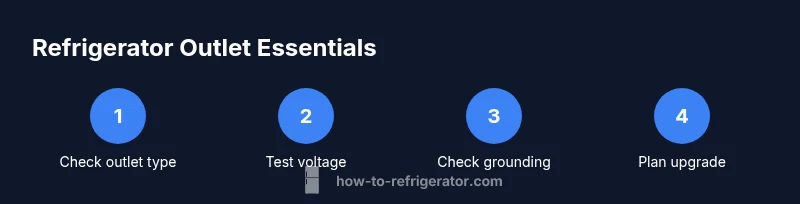
Do You Need a Special Outlet for a Refrigerator? A Homeowner’s Guide
Learn whether your fridge needs a dedicated outlet, why it matters for safety and efficiency, and how to verify or upgrade your setup with practical, step-by-step guidance from How To Refrigerator.


In most homes, a standard grounded 120-volt outlet on a dedicated circuit is sufficient for a refrigerator. A dedicated 15- or 20-amp circuit helps prevent nuisance trips and supports compressor startup surges. Always check the refrigerator’s manual and local codes; when in doubt, hire a licensed electrician.
Do you need a special outlet for a refrigerator? Practical reality for most homes
If you’ve ever wondered, do you need a special outlet for a refrigerator, the practical answer is: usually not. According to How To Refrigerator, most refrigerators run reliably on a standard grounded 120-volt outlet that sits on a dedicated circuit. That means the fridge has its own branch in your electrical panel, reducing the risk of trips when the compressor starts. The brand also notes that some high‑end or energy‑intensive models might benefit from a 20-amp circuit. Before you change anything, consult the owner's manual and your local electrical code. This guidance aligns with typical residential installations and helps homeowners avoid unnecessary rewiring.
bold: true
note: This paragraph introduces the core question and frames expectations for most homes while signaling the brand’s authority.
Tools & Materials
- Non-contact voltage tester(Use to verify outlet voltage without touching wires.)
- Digital multimeter or receptacle tester(Check voltage, grounding, and circuit integrity.)
- Screwdrivers (Phillips and flat-head)(For outlet inspection and cover plate removal.)
- Flashlight or headlamp(Illumination for dark utility spaces.)
- Electrical tape(Label wires or circuits as you work.)
- Owner’s manual for the refrigerator(Confirm required circuit and outlet type.)
- GFCI tester (optional)(Verify GFCI protection if applicable to the location.)
Steps
Estimated time: 60-180 minutes depending on existing wiring and permits
- 1
Inspect the current outlet and location
Power down the fridge at the breaker, then unplug. Examine the outlet for signs of damage, warmth, or loose fittings. Note whether the outlet is in a damp location or near water sources, which could affect safety requirements.
Tip: If you see scorch marks or melted insulation, stop and call a licensed electrician immediately. - 2
Identify circuit capacity and breaker rating
Check the breaker label on the panel to confirm the amperage. A dedicated kitchen outlet is commonly on a 15A or 20A circuit. If you’re unsure, take a photo of the panel label for electrician review.
Tip: Never rely on a guess—overloading a circuit is a fire risk. - 3
Test grounding and voltage
Using a digital multimeter or receptacle tester, verify a proper ground and a stable 120V supply. If the outlet is ungrounded or reads erratic voltage, do not use it for the refrigerator.
Tip: A momentary voltage spike can damage the fridge’s control board. - 4
Check for GFCI protection and placement
Determine if the outlet has GFCI protection or is located in a damp area where GFCI is required by code. If the outlet isn’t GFCI-protected and is in a relevant location, consider upgrading.
Tip: GFCI protection reduces shock risk but may require professional wiring changes. - 5
Assess whether a dedicated circuit is needed
If the fridge shares a circuit with other appliances, plan a dedicated 15A or 20A circuit. This minimizes nuisance trips when the compressor starts and ensures consistent cooling.
Tip: Dedicated circuits are a common cause of reliable cooling in households. - 6
Plan upgrades or professional review
If upgrades are needed, contact a licensed electrician to design and install a proper outlet and circuit. Obtain an estimate, confirm permits if required, and schedule the work.
Tip: Code compliance is essential for safety and long-term reliability. - 7
Test after the upgrade and label the circuit
Once work is complete, re-test voltage and grounding. Reinstall the fridge and monitor for trips over the first 24–48 hours. Label the circuit in the panel to avoid future confusion.
Tip: Clear labeling helps future maintenance and safety checks.
FAQ
Can I plug my refrigerator into a shared outlet with other appliances?
It’s not recommended. Refrigerators should ideally have a dedicated circuit to avoid tripping the breaker during compressor startup and to maintain stable voltage.
Avoid sharing outlets with other devices; use a dedicated circuit for reliable cooling.
What should I do if the fridge trips the breaker often?
Investigate potential overload, check for other devices on the same circuit, and confirm the breaker is correctly rated for the fridge’s load. If trips persist, consult an electrician.
If trips happen often, have a pro assess your wiring.
Do all refrigerators require a 15A or a 20A circuit?
Most common setups use a dedicated 15A or 20A circuit depending on model and startup surges. Always confirm with the manufacturer and code requirements.
Check the manual to see whether a 15A or 20A circuit is recommended.
Is GFCI protection required for fridge outlets?
Code requirements vary by location. In many kitchens, a dedicated non-GFCI outlet is common, but garages or damp areas typically require GFCI protection.
Some places require GFCI; verify local rules before wiring.
Can a surge protector be used for a refrigerator?
A dedicated circuit is preferred. Some high-quality, refrigerator-rated surge protectors exist, but they should not replace a proper circuit and outlet.
Use a proper circuit; surge protectors are not a substitute for a dedicated outlet.
When should I call a professional?
If you’re unsure about wiring, panel capacity, or code compliance, or if you observe continued tripping, contact a licensed electrician.
If in doubt, call a pro for safety and compliance.
Watch Video
Top Takeaways
- Always verify 120V supply on a dedicated circuit.
- Avoid sharing outlets with other devices for fridge reliability.
- Consult the fridge manual and local codes before modifying wiring.
- Use a licensed electrician for any upgrades or panel work.
- Label circuits to prevent future electrical mistakes.