Can You Put Food in the Refrigerator When It’s Warm? A Safe Cooling Guide
Learn whether warm foods can be refrigerated, how to cool quickly, and best practices to keep your fridge safe. How To Refrigerator explains the two-hour rule, container tips, and practical steps.


Yes, you can refrigerate warm foods, but act quickly. The goal is to bring hot dishes down to 40°F (4°C) within 2 hours. Use shallow containers, avoid stacking, and keep the fridge organized so air can circulate. If you can't cool fast enough, consider using an ice bath. This approach minimizes bacterial growth risk.
Can warm food be refrigerated safely? Key safety concepts
According to How To Refrigerator, the short answer is yes, with conditions. The question can you put food in the refrigerator when it's warm is common in busy kitchens. The safety backbone is to shrink the time hot foods spend in the so-called danger zone (roughly 40°F to 140°F or 4°C to 60°C). The faster you move food through that range, the lower the risk of bacterial growth. To reduce risk, start with quick cooling, then store items in the fridge at 40°F (4°C) or below, and avoid overloading shelves so cold air can circulate. Remember that not all warm foods cool at the same rate; liquids, emulsions, and dense dishes may require more surface area or stirring to lose heat evenly. This initial understanding helps you handle leftovers, sauces, soups, and casseroles without compromising safety or quality. For further guidance on refrigerator performance, see How To Refrigerator's maintenance guidance.
The danger zone and fridge temperature: what the numbers mean
Food safety hinges on limiting time in the “danger zone” where bacteria grow most rapidly. Refrigerators should be maintained at or below 40°F (4°C) to keep perishables safe. If your fridge runs warmer, spread out items, avoid crowding, and verify temperatures with a thermometer. Large pots and dense dishes can temporarily raise fridge temperatures, so plan to move them into shallow containers quickly and monitor temperature as you store. Keep dairy, meat, and ready-to-eat foods toward the back of shelves where temperatures stay the coldest, and away from the door where fluctuations are common. If you notice persistent warm spots, consult How To Refrigerator’s maintenance tips for improving airflow and cooling performance.
Two-hour rule and cooling timelines
Public health guidance emphasizes cooling foods to a safe temperature as quickly as possible. The basic rule is that perishable foods should be cooled to 40°F (4°C) within two hours of cooking; if ambient temperatures exceed 90°F (32°C), shorten that window to one hour. Break large batches into smaller portions to speed heat loss, and keep the cooling containers uncovered until they drop below 50°F (10°C) before covering. If you employ an ice bath or fan-assisted cooling, you can accelerate the process further. After reaching 40°F (4°C) or below, wrap and store in the fridge, ensuring air can circulate around items. These timeframes are designed to reduce the risk of bacterial growth while preserving flavor and texture. If you routinely cook large quantities, consider planning dedicated cooling zones or a separate shallow-pan system to maintain safety.
Practical cooling methods for hot foods
There are several practical methods to move heat out of hot foods quickly. Start by separating large dishes into shallow, wide containers with a depth of 1–2 inches. This increased surface area speeds cooling. An ice-water bath (not a direct ice bath on the food) can also be used to whisk heat away: place the container in a larger bowl filled with ice and cold water, and stir periodically. A gentle fan aimed at the container helps, but avoid placing items on the fridge floor or directly against cold coils. Stir if possible to disperse heat evenly, especially for sauces, soups, and stews. For dairy-heavy sauces, whisking frequently helps prevent separation. Always verify with a thermometer and move to the fridge as soon as the food drops below 50°F (10°C).
Containers, surface area and airflow: why size matters
Food containers should avoid heat-trapping thickness. Use shallow, wide containers and leave space for air to circulate around each item. Do not stack hot or warm containers directly against the fridge shelves; give cold air access to the back and bottom of each container. Label each container with the date and contents; this helps you rotate stock and minimize waste. If you must reheat leftovers, plan to reheat to at least 165°F (74°C) before re-serving. By managing surface area and airflow, you reduce the cooling time and keep the entire fridge working efficiently.
Common foods: poultry, rice, sauces, soups
Poultry and meats should be cooled rapidly in shallow containers and split into smaller portions to speed safe cooling. Rice and grains can clump if not cooled quickly, so spread them thin on a tray to maximize surface area. Sauces and gravies should be cooled rapidly; stir and then transfer to shallow containers. Soups and stews are ideal for quick cooling when divided into shallow pans. Always keep in mind the two-hour rule and avoid stacking hot items on top of each other. When in doubt, label with date and use within a recommended timeframe to preserve texture and safety.
Step-by-step workflow for warm-to-fridge leftovers
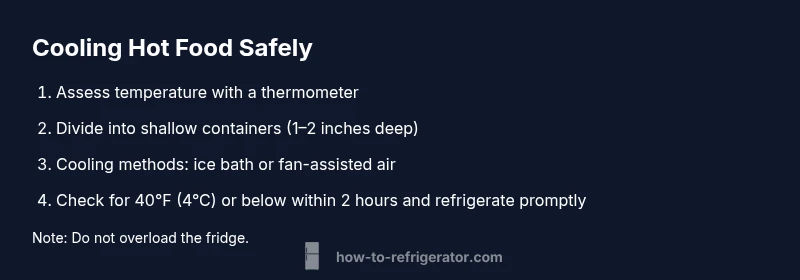
- Check the pot’s temperature with a thermometer to determine heat level. 2) Remove from heat and allow a brief rest to release most steam. 3) Portion into shallow containers (1–2 inches deep) to maximize surface area. 4) Initiate cooling with an ice-water bath or a fan; stir periodically. 5) Once the contents reach about 50°F (10°C) or lower, cover loosely and move to the fridge. 6) After 2 hours, verify that the internal temperature has reached 40°F (4°C) or below. 7) Label and rotate stock; reheat leftovers to 165°F (74°C) before serving. 8) Monitor fridge performance and adjust as needed for future batches. Estimated total time: 2–3 hours, depending on volume.
Fridge maintenance to support safe cooling
Keep coils clean and doors sealing properly to maximize cooling efficiency. Avoid overpacking shelves; cold air needs space to circulate. Position frequently used items toward the front, and place moisture-rich foods in sealed containers to prevent condensation buildup inside the fridge. Regularly check and calibrate your fridge thermometer to maintain the target 40°F (4°C). If your fridge struggles to stay cold, consult a repair professional to inspect condenser coils, compressor function, and door seals. These maintenance steps ensure your appliance supports safe cooling practices for warm foods.
Myths debunked: what actually helps in home kitchens
Myth: You should never put warm food in the fridge. Reality: It’s safe if you follow quick cooling guidelines and proper containerization. Myth: Steam should be trapped in the fridge for faster chilling. Reality: Trapped steam can raise humidity and promote spoilage. Myth: All leftovers need to be cooled on the counter first. Reality: Smaller portions and shallow containers can drastically cut cooling time. By focusing on heat transfer principles and practical steps, you’ll reduce risk and preserve quality without unnecessary delays.
Putting it all together: a quick kitchen-ready checklist
- Use shallow, wide containers for any hot foods.
- Divide large batches into smaller portions to speed cooling.
- Use an ice bath or a fan to accelerate heat loss.
- Verify temperature with a thermometer and aim for 40°F (4°C) within 2 hours.
- Do not overload the fridge; ensure air can circulate.
- Label with date and rotate stock to reduce waste.
- Reheat leftovers to 165°F (74°C) before serving.
Tools & Materials
- Food thermometer(Checks target 40°F (4°C) when cooling foods.)
- Shallow containers (1–2 inches deep)(Maximizes surface area for faster cooling.)
- Ice-water bath setup (large bowl, ice, water)(Helpful for rapid cooling; use with care to avoid spills.)
- Cooling rack or wire rack(Promotes air circulation under containers.)
- Kitchen timer(Tracks cooling milestones and 2-hour window.)
- Fridge thermometer(Ensures fridge stays at or below 40°F (4°C).)
- Labels and markers(Date-stamp and content labels for rotation.)
Steps
Estimated time: 2-3 hours
- 1
Assess temperature and quantity
Place a thermometer in the hottest portion of the food or use an internal temp reading to estimate heat level. Assess how much you’re cooling to determine container size and cooling method. This guides how aggressively you should chill.
Tip: Start cooling within 15 minutes of cooking for best results. - 2
Partition into shallow containers
Divide large pots into multiple shallow containers (1–2 inches deep) to maximize surface area and speed heat loss.
Tip: Avoid deep piles; air must reach the center. - 3
Initiate rapid cooling
Use an ice-water bath or a fan to accelerate cooling; stir occasionally to distribute heat evenly.
Tip: Never place containers directly on ice; use a bath setup. - 4
Check progress and transfer to fridge
When contents reach about 50°F (10°C) or cooler, cover loosely and move to the fridge.
Tip: Ensure air can circulate around containers in the fridge. - 5
Verify final fridge temperature
Within the 2-hour window, verify that the internal fridge temperature is at or below 40°F (4°C).
Tip: If still warm after 2 hours, split into more containers or speed cooling further. - 6
Label, rotate, and reheat safely
Label with date and contents; reheat leftovers to 165°F (74°C) before serving.
Tip: Use the oldest leftovers first to minimize waste.
FAQ
Can you put hot soup in the refrigerator?
Yes, after it has cooled enough to reach about 50°F (10°C) or lower, transfer to shallow containers and refrigerate. This minimizes time in the danger zone.
Yes—once your soup has cooled to around 50 degrees or lower, transfer to shallow containers and refrigerate promptly.
Is it safe to place steaming food directly into the fridge?
No. Direct steam can raise fridge temperatures and create condensation that promotes spoilage. Let the food cool briefly (or use a cooling method) before refrigerating.
No. Let hot items cool for a bit or use a cooling method before placing them in the fridge.
How long can warm food sit on the counter before refrigeration?
Per general guidelines, keep it out for no more than two hours, or one hour if ambient temperatures exceed 90°F (32°C).
Usually up to two hours on the counter, shorter if it’s very hot outside.
When should I freeze leftovers instead of refrigerating?
If you won't consume leftovers within 3–4 days, freezing them preserves quality and safety better than keeping them in the fridge.
If you won’t eat leftovers in a few days, freeze them to keep them safe and fresh.
What should I do if my fridge seems warm even after cooling?
Check the thermometer, ensure doors seal properly, and inspect coils; persistent warmth may indicate a system issue requiring professional service.
Check the temperature, door seals, and coils; if it stays warm, you may need a repair.
Watch Video
Top Takeaways
- Cool hot foods quickly to 40°F (4°C) within 2 hours.
- Use shallow containers and avoid crowding for fast cooling.
- Verify fridge temps with a thermometer and rotate stock.