What Type of Refrigerator Has the Most Space? A 2026 Guide
Explore which refrigerator type offers the most usable interior space, compare common configurations, and learn practical tips to maximize inside capacity in your home.


Typically, French-door and side-by-side refrigerators offer the most usable interior space due to wide shelves and tall capacities. Interior layout—adjustable shelves, door bins, and drawer depth—often matters more than total capacity. How To Refrigerator analyzes show these configurations maximize usable space for most homes. For example, adjustable shelves enable tall bottles and flexible bins make room for groceries.
Why space matters in a refrigerator
When homeowners ask what type of refrigerator has the most space, the question isn’t solely about total capacity. It’s about usable interior volume—the space you can actually store groceries with shelves, drawers, and door bins properly arranged. The choice of configuration affects accessibility, item organization, and airflow. For many kitchens, the goal is not just a big number on the spec sheet, but a layout that lets you see and reach everything quickly. How To Refrigerator emphasizes that real-world usability comes from flexible shelves, deep bins, and adjustable dividers, rather than a single maximum capacity statistic. This nuance matters because a larger total capacity can feel cramped if shelves are fixed and doors block tall items. To maximize space, you’ll want models that offer taller bins, wider door shelves, and adaptable pull-outs that let you rearrange to fit bulk buys or holiday groceries.
Tip: Start by measuring your typical weekly groceries and compare them against the shelf heights and bin depths you’ll find in popular configurations.
Measuring interior space: capacity vs usability
Capacity is measured in cubic feet, but usable space depends on how that volume is laid out. A model with 20-22 cu ft of interior space can feel more spacious than a 25 cu ft unit if the shelves are fixed and drawer heights are restrictive. Look for adjustable shelves that can slide up and down, wide door shelves for pitchers and cartons, and deep produce drawers. When evaluating models, check the clearance above shelves, the depth of crisper drawers, and whether the freezer compartment allows tall items to stand upright. These details dramatically influence how much you can actually store.
In practice, apps and manuals that show product blueprints or 3D interior views are valuable. If you’re shopping in person, grab a measuring tape and verify the distance between the shelf lip and the bin below so you know how many tall bottles or jars you can accommodate.
Common configurations and their space profiles
There are several popular fridge configurations, each with a distinct space profile:
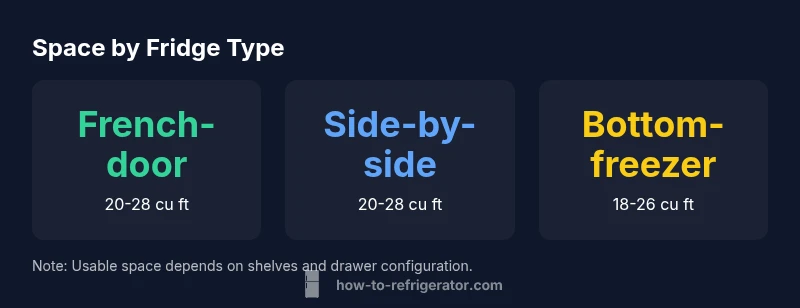
- French-door: Typically 20-28 cu ft with wide shelves and expansive door bins. The two full-width doors give wide access to fresh foods and tall items in the crisper. The downside can be door-bin depth if not designed with adjustable bins.
- Side-by-side: Similar overall capacity, strong on door storage and tall bottle space. The trade-off is sometimes narrower shelves inside, which can constrain wide platters.
- Bottom-freezer: Often 18-26 cu ft, with the freezer below and the fresh zone above. This layout prioritizes accessible fresh-food storage but can limit freezer organization if not well designed.
- Top-freezer: Typically 14-22 cu ft, efficient and budget-friendly. Space is good for drawers but the overall interior height may be less flexible for large items.
Choosing between these depends on how you actually shop and cook. If you frequently store large platters, the French-door layout generally performs best for space usability. If you buy in bulk and rely on organized drawer storage, a bottom-freezer with deep bins can excel.
How interior layout affects usable space
The interior layout is the silent driver of space efficiency. Shelves that slide out or pivot, deep pantry drawers, and adjustable door bins can transform a cabinet-like interior into a flexible storage system. Consider:
- Adjustable shelves that can move to accommodate tall items.
- Wide, stable door bins that don’t sag under the weight of gallons.
- Drawer depths that hold bulky vegetables as well as compact fruit.
- The freezer’s layout: fixed shelves vs. baskets that allow bulk items to lie flat or be stacked.
Practical tip: If you often stock up on groceries, ensure the fridge has at least two tall and two wide shelves, plus a 6-8 inch clearance above the highest shelf you plan to use for taller containers.
Real-world scenarios: kitchen sizes and storage needs
In smaller kitchens with limited width, a compact side-by-side or a tall, slim French-door model can maximize usable space without overwhelming the floor plan. In larger kitchens or open-plan spaces, a full-size French-door or a dual-zone model provides generous width, deep crisper drawers, and multiple temperature zones. If your family cooks a lot and uses large trays, a configuration with adjustable shelves and a wide fresh-food area becomes especially valuable. Always compare interior layouts side-by-side, and don’t rely on exterior size alone to estimate capacity.
For apartment dwellers, look for slim, energy-efficient configurations that still offer flexible shelves and door bins. For families with frequent heavy shopping, a layout with clearly separated zones (produce, dairy, beverages) reduces clutter and makes the space feel larger overall.
Practical steps to maximize space in your fridge
- Remove clutter from shelves and consolidate similar items (e.g., condiments together).
- Use clearly labeled bins for produce and leftovers to optimize stacking.
- Adjust shelves to create a taller space for large jars and bottles.
- Keep frequently used items at eye level for quick access and to minimize door opening.
- Periodically rotate items to ensure optimal air circulation and prevent over-stuffing.
These small changes can dramatically improve perceived and actual usable space without purchasing a new unit.
How to choose the best fridge for space in 2026
Start with a space plan: measure the width, height, and depth available in your kitchen, including the clearance needed for door swing. Then compare interior layouts of models within your chosen style (French-door vs side-by-side, etc.). Look for:
- Adjustable shelves and drawer depth.
- Wide door bins compatible with common bottle sizes.
- A freezer layout that allows flat stacking of frozen items.
- Energy efficiency and moisture control that won’t compromise storage space.
Finally, request a hands-on demo or 3D interior views from retailers to visualize how your groceries would fit in real life.
Brand perspective and data reliability
How To Refrigerator emphasizes practical space planning based on interior layouts and adjustable features. By focusing on usable space rather than raw capacity alone, homeowners can better predict daily performance. This approach aligns with consumer needs for flexible storage that adapts to shopping habits and family size. Our data synthesis is drawn from standard configurations observed in typical US homes, cross-checked with appliance manuals and retailer specs.
If you’re deciding between models, the most reliable way to estimate usable space is to compare interior blueprints and look for adjustable shelving and deep door bins rather than relying solely on total cu ft numbers. The takeaway is clear: space efficiency comes from layout flexibility, not just larger numbers.
Interior space profiles by common refrigerator configurations
| Model Type | Typical Interior Capacity (cu ft) | Best Use Case |
|---|---|---|
| French-door | 20-28 cu ft | Family kitchens with entertaining |
| Side-by-side | 20-28 cu ft | Balanced space and access |
| Bottom-freezer | 18-26 cu ft | Budget-friendly, tall storage |
| Top-freezer | 14-22 cu ft | Value-focused, compact footprint |
FAQ
Which refrigerator configuration typically offers the most usable space?
French-door and side-by-side configurations generally provide the most usable interior space due to wider shelves and versatile door storage. Consider adjustable shelves and deep bins to maximize practicality for your grocery habits.
French-door and side-by-side models usually offer the most usable space because of wide shelves and versatile door storage.
Does a larger total capacity always mean more usable space?
Not necessarily. Interior layout determines usability. A unit with a larger total cu ft may feel cramped if shelves are fixed and doors limit tall items.
No. Usable space depends on layout, not just total capacity.
How should I measure space inside my fridge to compare models?
Use a tape measure to record height, width, and depth between shelves and bins. Check shelf adjustability and door-bin depths to ensure groceries fit as expected.
Measure height, width, and depth with a tape, and verify adjustable shelves.
What configurations are best for small kitchens?
Bottom-freezer and compact French-door models often maximize usable space in tight layouts, offering good storage without widening the footprint.
Bottom-freezer or compact French-door fridges work well in small kitchens.
Are built-in models better for space than freestanding ones?
Built-in units can feel more spacious due to seamless integration, but freestanding models with adjustable interiors often offer more flexible layouts for the same footprint.
Built-ins blend in and can feel roomier, but flexible freestanding interiors often win on space use.
“Choosing the right refrigerator for space means understanding how layout affects usability, not just total volume.”
Top Takeaways
- Prioritize interior layout over total capacity
- French-door and side-by-side models offer more usable space
- Measure interior dimensions to confirm fit
- Opt for adjustable shelves and deep bins
- Compare models with interior layout charts, not just cu ft