What Are the Dimensions of a Refrigerator? A Practical 2026 Guide
Discover how refrigerator dimensions vary by style, how to measure space, and how to choose the right size for your kitchen. Practical tips for homeowners from How To Refrigerator.


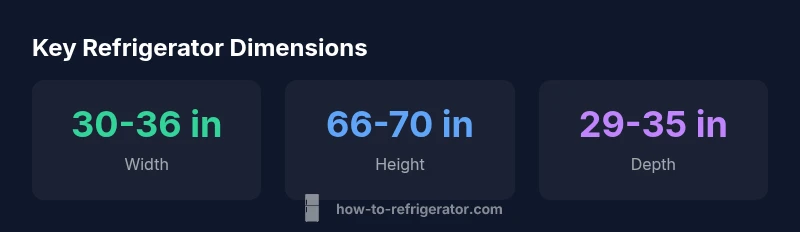
According to How To Refrigerator, the dimensions of a refrigerator vary by style, but typical external measurements fall within 30-36 inches wide, 66-70 inches tall, and 29-35 inches deep. Inside, usable space ranges widely based on shelves and configurations. To plan a fit, measure your doorway clearance, kitchen alcove height, and the space needed for door swing and ventilation.
Understanding how the dimensions vary by refrigerator style
Refrigerators come in several commonly used configurations, each with its own footprint and practical space needs. If you ask, what are the dimensions of a refrigerator, the simplest answer is that width, height, and depth all depend on the model style and doors. Typical external measurements fall within ranges that balance capacity with kitchen fit: about 30-36 inches wide, 66-70 inches tall, and 29-35 inches deep for many standard models. Counter-depth variants can be 24-30 inches wide and 28-32 inches deep, while full-depth, freestanding units push toward the 36-inch width and 70-inch height range. Internal arrangement also matters: French doors often yield larger usable space with taller doors, while top-freezer layouts may be a bit shorter and narrower.
According to How To Refrigerator, understanding these baseline ranges helps you plan a kitchen remodel or new installation with confidence. When assessing dimensions, consider both exterior footprints and how interior shelves, drawers, and crisper bins affect usable space. This context guides realistic expectations and reduces the chance of buying a unit that barely fits or blocks airflow. As you compare models, keep in mind the typical width, height, and depth, but also examine interior configuration and door swing.
External dimensions vs interior capacity: what actually fits inside
Many homeowners focus on exterior size, but the most important metric for daily use is interior capacity and how efficiently the space is organized. A typical refrigerator's interior usable space can vary widely even within the same external footprint due to shelf design, door bins, and crisper sizes. In general, you can expect interior volumes from roughly 18 to 30 cubic feet in standard residential models, with French-door and side-by-side configurations skewing toward the higher end. This range reflects varying insulation thickness, the ice-maker, and the number of shelves. When planning a kitchen, remember that interior capacity does not always scale linearly with exterior size. A slightly larger external dimension may translate to smaller usable space if the interior layout is suboptimal.
How To Refrigerator Analysis, 2026 shows that buyers should cross-check capacity with actual shelf layouts and whether an ice maker reduces usable space. If upgrading from an older model, compare the interior layout of new models side-by-side with your current use patterns, such as beverage storage, produce bins, and tall item clearance.
Measuring space accurately: doors, alcoves, and ventilation clearances
Measuring for a new refrigerator begins with the opening where the unit will live. Start with the width, height, and depth of the available space, then add clearance for doors to swing open fully and for proper airflow at the back and sides. A common rule is to allow at least 1 inch of clearance on the sides and back, and 2-3 inches for doors that require wide openings. Measure alcove constraints if the fridge sits flush with cabinetry, and check ceiling height if the unit has a tall top cap. Don’t neglect the doorway during delivery: some models require removing handles or doors, or disassembly in transit. Take into account any stairs, hallway turns, or corner access that could complicate installation.
For practical accuracy, measure twice and verify with a floor plan or a photo showing the installation area. Make a simple diagram labeling the wall behind the fridge, nearby cabinets, and any heat sources or vents. This method ensures you aren’t surprised by clearance issues during delivery.
Planning for different kitchen layouts: island kitchens, alcoves, and apartment-friendly spaces
If you have an island or a tight nook, or you’re working with a narrower doorway, you’ll want to evaluate whether a standard full-size fridge or a counter-depth model fits best. Counter-depth units sit closer to cabinet depth, typically reducing depth by several inches but also limiting internal capacity. For apartments or small kitchens, consider dimensions that emphasize width flexibility and door swing clearance over volume. In doors with tight corners, you may need to measure the path from street to kitchen to ensure the appliance can be brought inside and rotated into position without disassembly. In matters of placement, always check local building codes for venting and electrical outlets near the installation site.
When space is at a premium, a compact or 24- to 30-inch-wide model can be a game changer. These smaller footprints often preserve valuable floor space while still delivering essential refrigeration features.
Choosing the right size for your household: family size, food storage habits, and budget
The right size depends on your lifestyle, not just your kitchen footprint. A family that cooks daily and buys in bulk may benefit from a larger capacity and more flexible shelving, while singles or couples may prioritize energy efficiency and compact configurations. Start with a usage audit: how many gallons of beverages, produce, and dairy items do you stock weekly? How often do you entertain? Use these data points to balance exterior dimensions with interior layout efficiency. Budget considerations include energy ratings, ice maker impact on usable space, and potential needs for extra freezer storage. Remember, larger units consume more energy and require more installation space, so align size with actual needs rather than aspirational capacity.
Quick checks before you buy: a buyer's checklist
Before purchasing, verify: the external width, height, and depth fit your opening; there is adequate clearance for doors and ventilation; the interior configuration matches your storage patterns; the delivery path accommodates the unit’s height and width; and the installation site has proper electrical and ventilation provisions. If possible, read model floorplans and watch installation videos to anticipate any assembly needs. Finally, compare several configurations within your budget to identify the best balance of footprint, capacity, and energy efficiency.
Common refrigerator dimensions by model type
| Model Type | External Width | External Height | External Depth | Typical Interior Capacity | Notes |
|---|---|---|---|---|---|
| Standard Side-by-Side | "30-36 in" | "66-70 in" | "29-35 in" | "18-22 cu ft" | "Wide door access, balanced space" |
| French Door | "32-36 in" | "68-70 in" | "28-34 in" | "20-28 cu ft" | "Tall with broad door swing" |
| Bottom Freezer | "30-36 in" | "66-70 in" | "30-34 in" | "20-30 cu ft" | "Freezer below; versatile layout" |
| Top Freezer | "28-32 in" | "61-66 in" | "30-34 in" | "14-20 cu ft" | "Compact footprint option" |
FAQ
What are the standard exterior dimensions for a typical refrigerator?
Most standard refrigerators sit around 30-36 inches wide, 66-70 inches tall, and 29-35 inches deep, though exact sizes vary by model and configuration.
Most standard fridges are about 30 to 36 inches wide, 66 to 70 inches tall, and 29 to 35 inches deep.
How do I measure space for a new refrigerator?
Measure width, height, and depth of the opening, then add clearance for doors, ventilation, and adjacent cabinetry. Check door swing and ensure access for delivery.
Measure the opening and add space for doors and ventilation.
Do door handles affect installation?
Yes, account for handle projections in depth measurements and consider whether handles will clear doors and entryways during installation.
Remember to include door handle projections when measuring.
Can I fit a large fridge in a small kitchen?
Yes, sometimes a counter-depth or compact model fits better; compare external dimensions to your space and factor doorway access. Review layout efficiency.
A smaller footprint or counter-depth model may be a better fit.
What is the difference between exterior dimensions and interior capacity?
External dimensions describe the outer size; interior capacity is the usable space inside, influenced by shelves, bins, and layout.
Outside size isn’t the whole story—inside layout matters for storage.
“Accurate measurement and space planning reduce the risk of buying a fridge that won’t fit or will underperform in daily use.”
Top Takeaways
- Measure carefully before buying to avoid fit issues
- Different styles have distinct external footprints and interior layouts
- Interiors vary widely; always check shelves and door bins
- Choose counter-depth for a flatter kitchen look, not maximum capacity
- Plan space for clearance, ventilation, and delivery paths