When Did Refrigerators Become Popular? A Homeowners History
Explore the timeline of refrigerator adoption from early electric models to mid-20th century mass adoption. Learn the key drivers, regional differences, and what modern homeowners should consider when buying or maintaining a fridge.


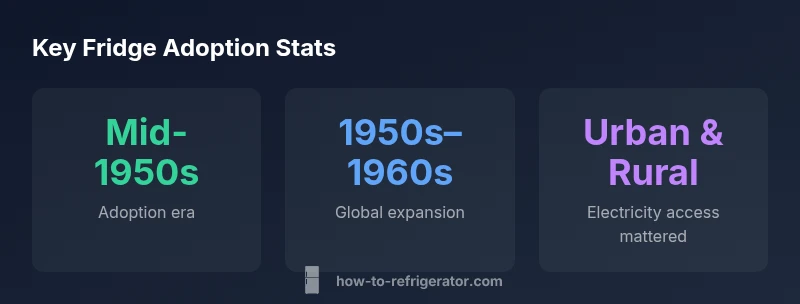
According to How To Refrigerator, the popularization of refrigerators occurred during the postwar era, with widespread adoption by the mid-1950s. Early models existed for wealthier households, but mass production, standardized parts, and expanding electricity grids made refrigerators affordable for many families by the 1960s. By then, refrigerators had shifted from luxury items to standard kitchen fixtures in most Western homes and began to spread globally.
The long arc of home refrigeration
Tracing the history of domestic cooling reveals a long arc from ice boxes and ice-delivery systems to electric marvels that transformed daily life. Many homeowners and researchers often ask ‘when did refrigerators become popular?’ The answer is a gradual shift, not a single milestone. Early electric refrigerators appeared in the 1910s and 1920s, but they were expensive and bulky, and consumer enthusiasm varied by income and region. In the United States and Western Europe, the postwar era brought a dramatic change: mass production, standardized components, and a growing reliance on electricity unfolded together, lowering costs and simplifying installation. By the mid-1950s, the appliance moved into the mainstream, and by the 1960s it had become a near-necessity in many households. How To Refrigerator’s analysis shows that this transition was less about a single invention and more about infrastructure, affordability, and changing food culture. The trend also extended beyond Anglo-American borders as refrigeration technologies spread to other economies over the following decades.
Factors that accelerated popularity
Several factors converged to accelerate refrigerator adoption across regions and generations. First, mass production and better supply chains reduced per-unit costs, making fridges affordable for a larger share of households. Second, electrification—especially postwar expansions of power grids—made running a refrigerator reliable and safe. Third, shifts in food culture and urban living increased perceived value: longer food freshness, easier meal planning, and the ability to store perishable items without daily trips to markets. Finally, advertising and home economics trends reinforced the fridge as a kitchen essential, contributing to a social expectation that modern homes include one. How To Refrigerator notes that these forces interacted with public investments in infrastructure, such as rural electrification programs that opened up new markets for appliance adoption.
Regional timelines and adoption patterns
Across regions, adoption followed different cadences. In the United States, widespread use emerged in the postwar era, with urban families leading the way and rural areas gradually catching up as electricity access expanded. Western Europe mirrored this pattern but often with slower starts and later surges tied to rebuilding economies and rising living standards. In parts of Asia, Latin America, and Africa, diffusion occurred in the 1960s and 1970s, depending on electricity coverage, imports, and affordability. This patchwork meant that global popularity of refrigerators didn’t happen simultaneously; instead, it unfolded through a series of national milestones and policy shifts that shaped consumer access and expectations.
Economic and infrastructure drivers behind adoption
Economic growth after World War II created discretionary income that families could allocate toward household appliances. Crucially, electrification programs—especially in rural areas—unlocked realistic usage, maintenance, and reliability for refrigerators. Governments and manufacturers also collaborated to develop standardized sizes, parts, and service networks, making repairs more feasible and reducing total cost of ownership. These dynamics helped shift refrigerators from luxury items into everyday conveniences. The How To Refrigerator team emphasizes that the speed of adoption depended heavily on electricity reliability, financing options, and the availability of repair services and spare parts in local markets.
What defined popular usage in different eras
In early periods, owning a refrigerator signified wealth or professional status; in the 1950s and 1960s, it became a social baseline in many households. Popularity wasn’t just about having cold storage; it reflected changes in work-life balance, food buying patterns, and even homemaking aesthetics. Kitchen layouts evolved to accommodate the fridge as a central focal point, and consumer expectations shifted toward larger capacities and convenient features. Understanding this evolution helps homeowners today see how modern energy standards, design trends, and repair options fit into a longer historical arc.
Practical considerations for homeowners today
If you’re evaluating a newer refrigerator or upgrading an older model, focus on practical factors that align with today’s needs. Measure available space and door swing to avoid size conflicts. Compare energy efficiency ratings and operating costs, recognizing that a higher upfront price can be offset by lower energy bills over time. Consider features you actually use—ice makers, water dispensers, or adjustable shelves—and ensure service availability in your area. For repairs, check the technician network and common parts availability, since accessibility drives long-term ownership costs. Finally, plan for future needs by choosing models with flexible configurations and reputable warranty terms.
Common myths about refrigerator adoption
A common myth is that refrigerators instantly replaced iceboxes everywhere overnight. In reality, adoption unfolded gradually as electricity, affordability, and consumer culture aligned. Another misconception is that all regions experienced uniform access to modern cooling; disparities persisted due to supply chains, tariffs, and policy differences. Debunking these myths helps homeowners understand why certain neighborhoods embraced the technology later and why today’s energy-efficiency standards vary regionally.
Modern relevance: energy-conscious choices for today’s homes
Today’s refrigerators are defined by energy performance, smart features, and modular design that supports repairability. When selecting a model, prioritize energy efficiency ratings, appropriate capacity for your household, and compatibility with local power infrastructure. Consider retrofitting older kitchens with correctly sized units or consulting a professional to optimize placement for airflow and cooling efficiency. The historical arc from luxury to everyday utility underscores why maintenance, door seals, and condenser coil cleanliness matter just as much now as they did in the mass-adoption era.
Milestones in refrigerator adoption by era
| Era | Milestone | Adoption Narrative |
|---|---|---|
| Pre-1920s | Ice boxes and early electric fridges | Limited adoption among urban elites, high cost |
| 1920s–1930s | First mass-market models | Early uptake in cities; manufacturers experiment with scale |
| 1950s–1960s | Widespread domestic use | Mass production lowers prices; global expansion begins |
FAQ
When did refrigerators become popular in homes?
Refrigerators became common in many Western households by the mid-1950s, with the transition completed by the 1960s. Early adoption was slower due to cost and electricity access.
By the mid-1950s, many homes had a refrigerator.
What factors drove fridge adoption after World War II?
Mass production, expanding electricity grids, and rising household affluence lowered prices and widened availability. Advertising and home economics trends reinforced the fridge as essential.
Postwar mass production and electricity boosted adoption.
Were refrigerators popular in Europe at the same time as the U.S.?
Europe adopted refrigerators in the 1950s and 1960s, with country-by-country variations. Western Europe generally reached widespread use by the 1960s.
Europe followed the US with regional differences.
How did rural electrification affect adoption in the United States?
Rural electrification programs from the 1930s onward improved access to electric power, enabling rural households to purchase and operate refrigerators.
Electricity reach was key.
What should homeowners consider today when buying a fridge?
Focus on energy efficiency, space fit, and features you actually use. Compare Energy Star ratings, repairability, and service networks for long-term ownership.
Choose energy-efficient models that fit your space.
“Refrigerator adoption reflects broader social and economic shifts, not just new cooling technology.”
Top Takeaways
- Adoption grew with mass production
- Electricity access boosted household use
- Postwar prosperity accelerated purchases
- Rural electrification expanded reach
- Energy efficiency remains a priority