How Much Does It Cost to Run a Refrigerator Each Month
A practical, data-driven guide to estimating monthly fridge running costs, with typical ranges, regional price effects, and cost-saving strategies.


On average, a modern refrigerator costs roughly $1.50 to $6.00 per month to run, depending on size, efficiency, and local electricity rates. More efficient models and smaller units tend toward the lower end, while older, larger refrigerators in high-rate regions can push costs higher. Seasonal thermostat tweaks and performance differences between models can shift monthly bills by a couple of dollars.
Understanding monthly fridge running costs
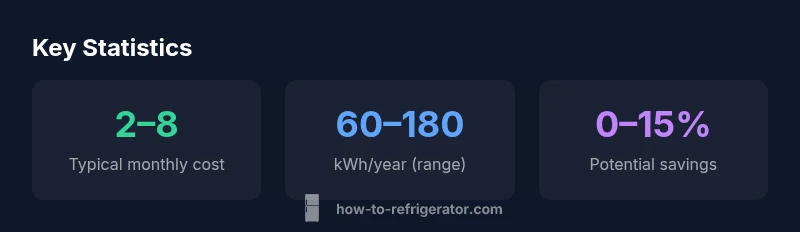
If you’re answering the question of how much does it cost to run a refrigerator for a month, the calculation is straightforward but the result varies widely. The cost depends on two things: energy use (measured in kilowatt-hours per year) and the price you pay per kilowatt-hour. A simple formula is: monthly cost ≈ (annual kWh / 12) × price per kWh. For example, a fridge that uses 120 kWh/year at $0.15 per kWh would cost about $1.80 per month. In practice, modern, energy-efficient models typically land in roughly $2–8 per month, while older or larger units in high-cost regions can push higher.
Energy guides and label information help set expectations. The EnergyGuide label provides a baseline energy usage figure you can compare against similar models. Your actual bill will be shaped by climate (ambient temperature), how often you open the door, and whether the unit frequently performs defrost cycles. How To Refrigerator Analysis, 2026 provides typical ranges to anchor your budgeting and to compare options before you buy.
How electricity rates shape monthly costs
Electricity prices vary widely by region and utility. A higher price per kilowatt-hour raises the monthly cost for the same energy use. If you live in an area with time-of-use pricing, the fridge’s compressor often cycles during off-peak hours, which can help slightly if you align usage with cheaper periods. To estimate your own monthly cost, locate the rate per kWh on your bill (usually cents per kWh) and multiply by the fridge’s monthly energy use. Remember that some plans include fixed monthly charges that factor into your overall bill. Understanding the rate helps you translate energy use into a realistic figure and compare models more accurately.
Estimating costs for different fridge types and scenarios
Fridges vary a lot in energy use based on size, configuration, and efficiency. A compact apartment fridge typically uses less energy than a full-size kitchen model; a standard top-freezer sits in between, while large side-by-side or French-door units consume more energy. Even among similar sizes, efficiency matters—Energy Star or inverter-driven compressors can drastically cut annual kWh. Rough ranges (kWh/year) can guide budgeting: compact/fridge-freezer 60–150; standard 150–350; large or high-end 300–700+. At typical electricity rates (roughly $0.12–$0.20 per kWh), monthly costs would approximate $0.60–$3.50 for compact, $1.50–$6.00 for standard, and $3.60–$14.00 for large units. These figures illustrate how model choice and usage patterns influence monthly bills.
Practical steps to measure and reduce your costs
Start with the EnergyGuide label or product specs to find annual kWh. If that data isn’t available, estimate from size and age, then confirm with a meter when possible. A Kill-A-Watt or similar meter can measure consumption over a 24–72 hour period to refine your estimate. To reduce costs, try these steps:
- Keep door seals tight and clean; replace worn gaskets if needed.
- Clean condenser coils on the back or bottom of the unit to improve heat transfer.
- Keep the fridge away from heat sources and avoid leaving the door open longer than necessary.
- Set the fridge to about 37–40°F (3–4°C) and the freezer to 0°F (-18°C) as recommended ranges.
- Use energy-saving features when available; ensure modern units are not stuck in high-power modes.
- When replacing a unit, consider energy efficiency ratings and inverter technology to reduce long-term costs.
Seasonal considerations and budgeting tips
Costs can drift with seasons: in hotter months, the compressor may run more often to maintain cold temperatures, especially if doors are opened frequently. Use a simple seasonal budgeting approach: estimate a higher monthly cost in summer (by 10–20%) and a lower cost in milder months, then adjust once you have actual meter data. Small changes—like placing the fridge at a consistent ambient temperature, maintaining a steady inventory, and avoiding overloading the fridge—translate into tangible savings over the year. In short, steady usage patterns and good maintenance are your best allies for predictable, lower monthly costs.
Estimated monthly running costs by fridge type (illustrative ranges)
| Fridge Type | Typical Monthly Cost Range | Notes |
|---|---|---|
| Compact fridge (under 15 cu ft) | $1–3 | Small apartment or secondary unit |
| Standard kitchen fridge (15–25 cu ft) | $2–8 | Most homes; energy efficiency matters |
| Large side-by-side / French-door | $4–12 | Higher energy use, more space |
| Vintage or non‑Energy Star | $5–15 | Older units with higher energy use |
FAQ
What is the typical monthly cost to run a refrigerator?
Costs vary, but most modern fridges run roughly $2–8 per month. Larger or older models in high-rate regions can be higher. Use EnergyGuide labels and your local rate to refine this estimate.
Most households with modern fridges spend a few dollars a month, depending on usage and energy price.
Do energy-efficient refrigerators always cost less to run?
Typically yes. Energy-efficient models use less electricity, reducing monthly costs over the life of the appliance, though the upfront price may be higher.
In most cases, energy-efficient fridges spend less to run over time.
Can turning the thermostat down lower costs?
Lowering the thermostat (making the fridge colder) generally increases energy use, which raises costs. Set to the recommended range for best balance of safety and efficiency.
No—turning the thermostat down usually makes it cost more to run.
Is it worth replacing an old fridge to save energy?
If your fridge is 10–15+ years old and inefficient, upgrading can pay off in energy savings, especially with rebates and energy-efficiency incentives.
Replacing an old, inefficient fridge can be worthwhile if you factor in long-term energy savings.
What other factors affect monthly costs besides kWh?
Ambient temperature, door opening frequency, defrost cycles, and maintenance all influence energy use and monthly costs.
Things like how often you open the door and how hot your kitchen is can change energy use.
Where can I find my fridge’s energy use information?
Look for the EnergyGuide label on the appliance, check the product manual, or visit the manufacturer’s website for estimated annual kWh.
Check the EnergyGuide label or the manual to find annual energy use.
“Small changes in thermostat settings and regular door-seal maintenance can dramatically reduce monthly fridge running costs without sacrificing food safety.”
Top Takeaways
- Calculate monthly costs using annual kWh and your local rate.
- Expect a broad range: roughly $2–8 per month for modern fridges; higher for older units.
- Check EnergyGuide labels when shopping to compare efficiency.
- Small changes (seals, thermostat, routine maintenance) can noticeably reduce costs.