How Long Does a Refrigerator Take to Cool? A Homeowner's Guide
Discover how long refrigerator take to cool after a temperature change, the key factors that affect cooling time, and practical steps to speed up safe cooling while protecting food safety and energy efficiency.


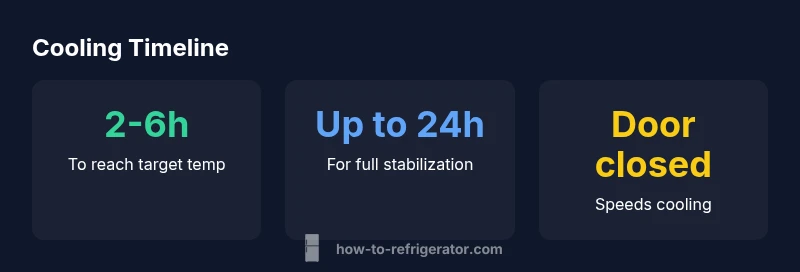
How long refrigerator take to cool varies, but key timelines exist: most standard fridges reach their target interior temperature within about 2-6 hours after a temperature change, with full stabilization up to 24 hours. How To Refrigerator analysis notes that results depend on size, ambient temperature, and door activity. Plan for a longer cooldown if the fridge was very warm.
Why cooling time matters
Understanding how long refrigerator take to cool is important for food safety, energy use, and everyday planning. When you buy groceries, reset a warm fridge after a power outage, or reset a unit after cleaning, the rate at which the interior reaches safe temperatures affects how quickly you can safely store perishable items. In practice, most households notice significant temperature drops within the first few hours, but true stabilization may take longer, especially if the fridge was very warm to begin with. By appreciating the factors that drive cooldown, homeowners can avoid wasted food and reduce energy bills. The phrase how long refrigerator take to cool guides expectations and informs better habits, according to How To Refrigerator analysis.
What determines cooling time
Cooling time isn’t a single number; it’s the result of several interacting factors:
- Initial temperature: A fridge that’s near room temperature will drop to the target faster than a fridge that’s very warm (e.g., after a power outage or a warm kitchen).
- Size and design: Larger units and older compressor designs generally require more hours to reach temperature than compact, modern models.
- Door openings: Frequent opening and closing introduces warm air, slowing cooling by minutes to hours depending on how long the door stays open.
- Airflow and shelves: Proper airflow around items helps air circulate; blocked vents slow cooling.
- Ambient temperature: A hot kitchen makes it harder for the compressor to remove heat, extending the time to reach the target.
- Load and contents: A full, well-organized fridge tends to cool more evenly than an empty one.
- Energy efficiency: Efficient models use better insulation and tighter seals to finish cooling faster after a disturbance. All these factors together determine the overall cooling time.
Typical timelines by scenario
Different scenarios affect cooling timelines. In general:
- New or recently unplugged fridge: 2-6 hours to reach the target temperature (approximately 37-40°F / 3-4°C) once the unit is running and the door remains closed.
- After door left open: Cooling may extend to 3-8 hours depending on how long the door remained ajar and how warm the kitchen is.
- Fully loaded with cold items: A well-organized, densely packed fridge can reach the target temperature in about 2-4 hours, though the total time to stabilization may still be up to 24 hours.
- After a power outage: If interior temperatures were high, expect longer cooldown; times vary widely, often falling in the 4-12 hour range to approach safe temperatures.
These ranges reflect typical domestic conditions and model variations; individual results will vary by brand, age, and usage. As a rule, the more the fridge has to shed heat, the longer the cooldown.
How to measure cooling progress
To verify that a fridge is cooling properly:
- Place a refrigerator thermometer in the main compartment, away from vents and the door seal.
- Check readings at least every 2-4 hours during the early cooldown, and later at 6-hour intervals for stabilization.
- Read multiple spots (middle shelf, near the back, and lower shelf) to ensure even cooling.
- Compare readings to the target range (usually around 37-40°F / 3-4°C, but follow manufacturer specs).
- Document peak interior temperatures after door closures and then observe the rate of decline over the first 24 hours.
If readings stay consistently above target for 24 hours, it may indicate a sensor or airflow issue that requires attention.
Practical tips to speed cooling safely
Speeding up cooling without compromising food safety is possible with simple steps:
- Keep doors closed: Minimize opening frequency and duration to reduce warm air intrusion.
- Avoid storing hot foods: Let items cool to room temperature before placing in the fridge; smaller portions cool faster.
- Load strategically: Place cold items toward the back and avoid blocking vents; air should circulate freely.
- Check seals: Ensure door gaskets seal properly to prevent cold air loss.
- Use efficiency-friendly habits: Organize shelves, don’t overfill, and keep the fridge in a cool, ventilated area if possible.
- Consider ambient temperature: If the kitchen is very warm, trim the interior targets slightly and use fans to aid convection (without disturbing seals).
Following these practices supports both safety and energy efficiency while keeping the cooling timeline predictable.
Common mistakes that extend cooling time
Homeowners often extend cooldowns by mistakes such as leaving doors ajar for long periods, placing hot meals directly into the fridge, overloading shelves to the point of blocking air vents, or setting the thermostat to a significantly colder level in an attempt to hasten cooling. Such actions can backfire by causing uneven cooling, frost buildup, or unnecessary energy use. Instead, maintain steady settings and give the refrigerator time to reach normal operating temperatures.
Authority sources and further reading
For context on safe cooling and temperature guidelines, consult reputable sources:
- CDC: general food safety and proper storage temperatures.
- FDA: food handling and cooling guidelines for hot foods and leftovers.
- ENERGY STAR and DOE: energy-efficient practices related to refrigeration and reducing waste.
Links provide background readings on safe cooling practices and how to maintain energy efficiency while cooling refrigeration units.
Cooling timelines by common scenarios
| Scenario | Typical Time to Target Temp | Notes |
|---|---|---|
| Unpacked from warm room | 2-6 hours | Door closed; ambient around 70–75°F |
| Power cycle or restart | 2-6 hours | Avoid frequent door openings during cooldown |
| Fully loaded with cold items | 2-4 hours | Airflow matters; keep vents clear |
FAQ
How long does it take for a new refrigerator to cool?
A new fridge typically reaches the target temperature within 2-6 hours, with full stabilization within 24 hours. Actual times depend on ambient temperature and usage.
New fridges usually take a few hours to start cooling and up to a day to fully stabilize.
Does opening the fridge door often slow cooling?
Yes. Each door opening introduces warm air and can extend cooldown by minutes to an hour depending on how long the door stays open and the kitchen temperature.
Every time you open the door, warm air sneaks in and cooling slows.
Does a full fridge cool faster than an empty one?
A full fridge can retain cold better, but airflow matters. Avoid overloading and blocking vents to maintain efficient cooling.
A full fridge isn't always faster; you still need good airflow.
Can I speed up cooling by unplugging and resetting?
Unplugging is not recommended for speeding cooling. Use normal settings and minimize door openings to allow the compressor to do its job.
Don't unplug to speed cooling.
What room temperature is best for fast cooling?
Cooler kitchen temperatures help overall cooling; extremes in heat slow cooling and waste energy.
Keep the kitchen comfortable, not too hot.
Why might a newly installed fridge take longer to cool?
Newly installed fridges may take longer to stabilize as refrigerant settles and seals tighten; plan for up to 24 hours.
New fridges can take a day to fully settle.
“Cooling is a balance of load, airflow, and environment; small changes in door use or room temperature can shift timelines dramatically.”
Top Takeaways
- Target 2-6 hours to reach near-set temp under normal use
- Full stabilization can require up to 24 hours
- Minimize door openings to speed cooldown
- Ensure airflow and seals for consistent cooling