What Price Refrigerator: A 2026 Homeowner Buying Guide
Discover refrigerator price ranges for 2026, hidden costs, and money-saving strategies. This buying guide explains types, features, and how to estimate total costs for a smart, long-lasting purchase.


Refrigerator prices generally range from about $400 for compact, basic models to $2,500 or more for high-end French-door units, with mid-range families commonly spending $800–$1,800. In 2026, most buyers find the best value in mid-size models with efficient compressors and essential features like an ice maker and water dispenser. According to How To Refrigerator, your exact price depends on size, features, and brand.
Understanding the price landscape for a refrigerator
Prices for refrigerators are not a single number; they reflect size, type, energy efficiency, and features. The cheapest units fit tight spaces and offer basic cooling, while mid-range models balance capacity with efficiency. Premium models add features such as multi-zone cooling, integrated ice makers, smart controls, and more durable finishes. When planning a purchase in 2026, homeowners should judge value by total cost of ownership, including energy use and long-term maintenance. According to How To Refrigerator, price bands cluster around three core tiers: compact or apartment fridges, standard family-sized units, and premium wide-format designs. Budget-conscious buyers can focus on top-freezer or bottom-freezer basics, while families prioritizing convenience may prefer French-door or side-by-side configurations. The role of energy efficiency matters more than ever; efficient compressors and modern insulation can reduce operating costs by hundreds of dollars over the appliance’s lifetime. In short, the sticker price is only part of the story, and a smart shopper weighs capacity, layout, and efficiency together. How To Refrigerator’s analysis emphasizes a goal: buy the fridge that fits both your space and your wallet.
Price ranges by fridge type
Different configurations come with different price ladders. Here are typical ranges to help you budget:
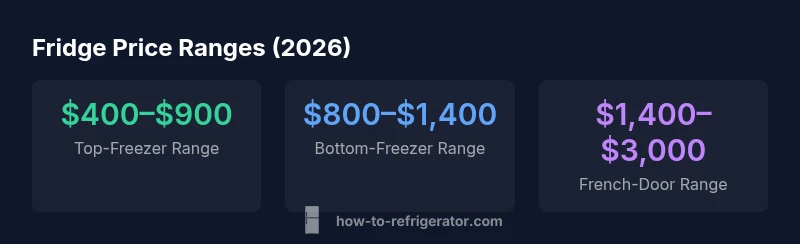
- Top-freezer: $400–$900
- Bottom-freezer: $800–$1,400
- Side-by-side: $1,000–$2,000
- French-door: $1,400–$3,000
- Compact apartment fridge: $300–$700
Keep in mind that features, finishes, and energy ratings can shift these bands. As a rule, smaller units cut upfront costs but may push you toward higher energy use per cubic foot. Larger, feature-rich models deliver more space and convenience but at a premium. If you’re balancing space with long-term operating costs, mid-range mid-size models often deliver the best value per cubic foot.
How to estimate price for your needs
Estimating price starts with a clear plan. Use these steps to project your costs and avoid sticker-shock:
- Measure your available space (width, height, depth) and check door clearance for the chosen model.
- Assess household size and typical storage needs; target about 1–1.5 cubic feet per person as a starting point.
- List must-have features (ice maker, water dispenser, adjustable shelves, smart controls).
- Decide on energy efficiency (ENERGY-STAR rating) and finish/style that matches your kitchen.
- Compare retailers: online vs in-store prices, delivery charges, and installation requirements.
- Factor separate costs: delivery, old appliance removal, water line kit, and potential disposal fees.
- Look for rebates or financing offers that can reduce effective cost.
By applying these steps, homeowners can arrive at a realistic price target and choose models that meet both space and budget constraints. How To Refrigerator recommends prioritizing total cost of ownership over sticker price to maximize long-term value.
Hidden costs and value considerations
Many buyers overlook the ancillary costs that accompany a new refrigerator. Delivery fees can vary widely; installation may require water line connections or electrical upgrades. Some models require a water line kit, and old appliance haul-away can add to the bill. Warranty and service plans offer peace of mind but add to upfront costs. Finally, operating costs depend on energy efficiency; a higher upfront price can be recouped over time through lower electricity use. When evaluating value, compare not just the initial price but estimated energy bills over 5–10 years, maintenance needs, and the reliability history of the model. A careful assessment helps prevent buyers from overspending on bells-and-whistles they won’t use.
Tips to save on price
Smart shoppers save by timing purchases and leveraging retailer programs:
- Shop during major sale cycles (holiday weekends, end-of-quarter events) and look for floor models or open-box deals.
- Compare prices across retailers and use price-matching policies when available.
- Check for energy rebates, tax incentives, or manufacturer promotions that reduce effective cost.
- Consider refurbished or gently used floor models with full warranties from reputable sellers.
- Negotiate delivery options; some retailers offer free setup or haul-away discounts.
- Evaluate financing offers with zero-interest periods to spread costs without interest.
Following these strategies can significantly reduce the total price of refrigerator purchases without compromising quality or warranty.
What affects price: features, efficiency, capacity
Price is driven by a combination of size, line configuration, and finish. Floor space dictates capacity, while exterior styling—stainless steel, counters, or custom panels—adds cost. Features such as ice makers, water dispensers, humidity-controlled crisper drawers, adjustable shelving, and smart connectivity contribute to higher prices. Efficiency ratings influence long-term energy costs, sometimes offsetting a higher upfront expense if usage is substantial. Finally, brand premium and warranty options affect the bottom line. Understanding these levers helps homeowners tailor a purchase to fit both their kitchen and budget, ensuring that every dollar aligns with actual needs and usage.
Price ranges by fridge type
| Fridge Type | Typical Price Range | Key Considerations |
|---|---|---|
| Top-freezer | $400–$900 | Most affordable; compact footprint; basic features |
| Bottom-freezer | $800–$1,400 | Better organization; mid-range energy use |
| Side-by-side | $1,000–$2,000 | More features; larger footprint; higher energy use |
| French-door | $1,400–$3,000 | Largest capacity; premium features; highest price |
| Compact apartment fridge | $300–$700 | Small footprint; limited features |
FAQ
What is the typical price range for a new refrigerator in 2026?
Refrigerator prices broadly fall into compact, mid-range, and large categories, with most buyers in the $800–$1,800 range. Costs vary by size, features, and efficiency.
Prices vary by size and features; expect the ballpark to be from $400 for small models to $2,500 for premium units.
Do energy-efficient models cost more upfront?
Yes, energy-efficient models often carry a premium up front, but they typically save on operating costs over time. Compare payback periods and estimated energy usage.
A small upfront premium can lead to lower energy bills over time.
Is it worth buying a floor model?
Floor models can offer discounts, but check warranty and cosmetic wear. Ensure the compressor and seals are intact and serviceable.
Floor models can be cheaper; verify warranty and condition.
What hidden costs should I budget for?
Delivery, installation, water line kit, disposal fees, and possible extra electrical work are common hidden costs to consider.
Don’t forget delivery, installation, and disposal fees.
How do I compare prices across retailers?
Use price trackers, check sales cycles, and inquire about price matching and online-only promotions to maximize savings.
Compare prices across stores and look for promotions.
What size fridge should I buy?
Measure the space carefully and consider your household’s storage needs. A common guide is 1–1.5 cubic feet per person, adjusted for layout and购物 habits.
Measure the space and think about your needs.
“Pricing for refrigerators reflects size, efficiency, and features, not just brand prestige.”
Top Takeaways
- Measure your space before shopping.
- Compare price ranges by fridge type.
- Budget for delivery and installation.
- Look for energy-efficient models to save long-term.
- Shop during sales and use rebates.