Top Refrigerator Bottom Freezer: A Practical Comparison Guide
A focused comparison of top-freezer and bottom-freezer refrigerators, examining accessibility, energy use, storage, and cost to help homeowners choose the best configuration for their kitchen.


For most homeowners, a bottom-freezer refrigerator offers better daily access and improved organization, while a top-freezer model typically delivers lower upfront cost and dependable reliability. This comparison evaluates these two common configurations on layout, energy use, maintenance, and long-term value to help you decide which fits your kitchen and budget.
What these two configurations mean in practical terms
A top-freezer refrigerator places the freezer at the top and the refrigerator compartment below. A bottom-freezer model moves the freezer to the bottom, leaving the more frequently accessed fresh-food section at eye level. For many kitchens, this simple layout difference has a meaningful impact on daily use, storage organization, and overall energy efficiency. In this guide, we define the two configurations and outline the core trade-offs homeowners face when deciding between a top refrigerator bottom freezer setup. According to How To Refrigerator, choosing between top-freezer and bottom-freezer configurations often comes down to daily usability, kitchen layout, and budget. The How To Refrigerator team found that while both layouts share core refrigeration technology, subtle differences in shelf ergonomics, freezer access, and door position can drive satisfaction or frustration in real-world use.
Accessibility and kitchen ergonomics
The position of the freezer influences how you reach for items during common tasks. Top-freezer designs keep the freezer at or near shoulder height, which some users find convenient for grabbing frozen staples. Bottom-freezer models put the freezer lower, while keeping fresh-food shelves at or near eye level, reducing bending and enabling faster access to frequently used items. For households with multiple cooks or limited kitchen space, the bottom-freezer layout often feels more intuitive for everyday meal prep. Consider your height, seating arrangement, and how you typically unload groceries when evaluating these layouts. The goal is to minimize bending, maximize quick access to favorites, and maintain an orderly interior that reduces food waste.
Energy efficiency and operating costs
Thermal performance and insulation quality influence long-term energy bills more than the label alone. Modern bottom-freezer models frequently leverage improved insulation and door seals, which can translate to steadier temperatures and lower energy use during peak hours. Top-freezer machines, especially older or compact models, can be energy-efficient too, but the overall efficiency depends on cabinet depth, door opening patterns, and compressor design. In practice, choosing Energy Star-rated options across either configuration helps standardize efficiency gains and reduce ongoing costs, particularly for households that run the fridge continuously. How To Refrigerator notes that while both layouts have efficient options, bottom-freezer models often pair with better interior organization that reduces temperature fluctuations caused by door openings.
Storage layouts and food organization
Shelf adjustability, bin sizing, and door rack design define how much you can store and how easily you access it. Top-freezer models typically offer straightforward layouts with strong visibility for fresh items, but may require more careful stacking of frozen foods due to shelf height. Bottom-freezer units emphasize drawer-style or glide-freezer compartments that keep frozen foods separated and accessible, at times offering more vertical space for tall items in the refrigerator section. Both configurations benefit from flexible shelving, crispers, and clearly labeled compartments. If you regularly prepare meals in bulk or rely on organized snack stations, a bottom-freezer design often simplifies daily routines and reduces rummaging.
Reliability, repairs, and parts availability
Both top-freezer and bottom-freezer models share common refrigeration components such as compressors, evaporators, and coils. Availability of parts and service networks can influence long-term reliability and repair costs. In general, top-freezer designs have a longer history with broad parts availability, sometimes translating to lower repair complexity for older units. Bottom-freezer designs, while popular and broadly supported, can involve more complex mechanisms in the freezer drawer and door assemblies. When selecting a model, prioritize widely supported brands and confirm the local service network supports your chosen configuration. Routine maintenance—clean coils, check door seals, and monitor drainage—helps prevent costly repairs later on.
Sizing, capacity, and kitchen fit
Capacity is often stated in cubic feet, but usable space depends on interior design and shelf orientation. Top-freezer refrigerators tend to be shallower in depth, which can be advantageous in tight kitchens, while bottom-freezer models usually extend slightly deeper to accommodate their larger freezer compartments. If your kitchen space is constrained, measure width, height, and depth with door swing in mind. Remember that some configurations require extra clearance for air circulation and door opening paths. In smaller homes, a compact top-freezer can be the most sensible option; in larger kitchens where meal prep is frequent, a bottom-freezer approach can optimize daily workflow.
Price ranges and total cost of ownership
Upfront costs vary by brand, size, and features, with top-freezer models typically offering lower initial prices and a wider selection. Bottom-freezer refrigerators often command a premium due to their more complex interior layouts and broader storage capabilities. Over the life of the appliance, energy usage and maintenance costs contribute to total ownership costs. If you expect heavy usage or a busy household, it can be prudent to invest in a slightly higher-priced bottom-freezer model with strong insulation and reliable components. Always balance initial price against expected energy savings and reliability over time.
Common myths and misconceptions
A frequent belief is that bottom-freezer models are always more energy-efficient; while this can be true for some modern designs, energy efficiency is highly model-specific. Another myth is that top-freezer units are outdated; in reality, many top-freezer models still offer competitive efficiency, strong reliability, and lower upfront costs. Finally, some shoppers assume that more shelves or bins automatically improve organization; the key is the interior layout and labeling to support your shopping patterns and cooking habits. Evaluate features such as adjustable shelves, crisper drawers, and door bin capacity to determine what actually improves day-to-day use.
How to choose based on lifestyle
If you cook for a crowd or meal-prep often, a bottom-freezer layout may accelerate daily tasks by keeping fresh foods at eye level and ensuring quick access. Families on a tighter budget or those prioritizing straightforward maintenance might prefer top-freezer models for their simplicity and broad availability. For energy-conscious households, target Energy Star-rated units in either configuration and compare year-over-year energy consumption. Your decision should hinge on how you use the fridge most days, how much you value ease of access, and the total cost of ownership over several years. The choice is not about one being universally superior; it’s about which design better aligns with your routine.
Cleaning, maintenance, and defrost considerations
Both configurations benefit from regular cleaning: wipe down shelves, clean coils, and inspect door gaskets. Frost-free (automatic defrost) models reduce manual defrost tasks, but even these require occasional maintenance to prevent frost buildup in harder-to-reach corners. With bottom-freezer models, be mindful of drawer seals and potential moisture buildup around the freezer. For top-freezer units, ensure the lower refrigerator compartment remains accessible and organized to prevent repeated digging for items. A simple monthly cleaning routine and a quick coasting of any lubricated slides can extend the life of either configuration.
Installation and space planning
Before purchase, verify the fridge will fit through doors and into the intended alcove with the doors swinging in the correct direction. Measure clearance for ventilation and account for adjacent cabinetry. If your kitchen has an existing water line or ice-maker, ensure the plumbing supports your chosen model and that the line length is adequate for future installation. Some layouts benefit from removing an adjacent cabinet for extra clearance, especially if you’re replacing a larger bottom-freezer with a compact top-freezer. Proper space planning minimizes installation surprises and protects the appliance from improper airflow.
Upgrade paths and transitioning between configurations
Moving from a top-freezer to a bottom-freezer model is common as households grow or cooking habits shift, but consider cabinet depths, door swing, and space availability. When upgrading, you’ll want to compare energy ratings across both configurations and check for the best warranty options. If you’re content with a single purchase rather than frequent changes, focus on robust build quality, service availability, and interior layout that suits your day-to-day needs. The transition can be smoother when you plan for the future and select a model that accommodates a variety of storage demands.
Comparison
| Feature | Top-Freezer | Bottom-Freezer |
|---|---|---|
| Accessibility to fresh foods | Fridge section at eye level, freezer on top | Fresh foods at eye level, freezer at bottom |
| Energy efficiency | Varies by model; older units may be less efficient | Typically strong efficiency with modern insulation |
| Initial price range | Lower upfront cost on average | Moderate to higher upfront cost depending on features |
| Storage flexibility | Standard interior, straightforward layout | Flexible shelves and drawers for varied storage |
| Best for | Cost-conscious buyers and compact kitchens | High-usage kitchens and households prioritizing access |
Strengths
- Lower upfront cost typical for top-freezer models
- Wide selection and easy-to-find parts
- Reliable performance with fewer moving parts
- Compact depth can fit tighter kitchens
Cons
- Bottom-freezer often offers better daily access to groceries
- Some bottom-freezer models cost more initially
- Organization may be more complex in older bottom-freezer designs
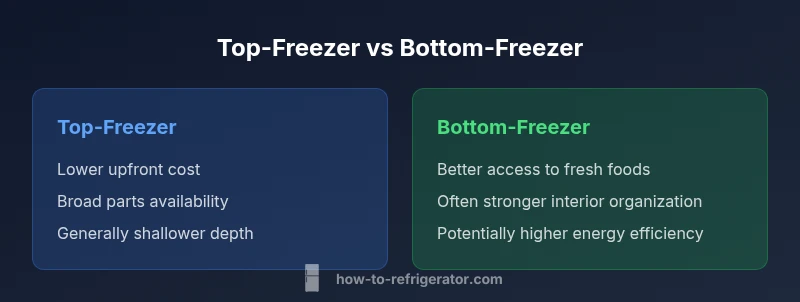
Bottom-freezer generally offers better daily usability and energy efficiency, but top-freezer remains cost-effective and reliable.
For most households, prioritize daily access and annual energy usage. Bottom-freezer models win on convenience and efficiency in modern designs, while top-freezer models shine for budget-conscious buyers with straightforward maintenance.
FAQ
What is the main difference between top-freezer and bottom-freezer refrigerators?
The main difference is the location of the freezer: top-freezer puts the freezer above the fridge, while bottom-freezer places the freezer below the fresh-food compartment. This affects accessibility, layout, and daily use.
Top-freezer places the freezer on top; bottom-freezer moves it to the bottom. That changes how you reach items daily.
Which configuration is more energy-efficient?
Energy efficiency depends on the model, but modern bottom-freezer designs often achieve strong efficiency through improved insulation and drawer layouts. Look for Energy Star ratings regardless of configuration.
Energy efficiency varies by model, but look for Energy Star regardless of whether you choose top or bottom-freezer.
Are bottom-freezer models more expensive to repair?
Repair costs depend on the specific model and parts availability. Generally, both configurations share common components; choose a model from a brand with good service coverage in your area.
Repair costs depend on the model and parts availability. Pick a brand with strong local service.
Is a top-freezer better for small kitchens?
Top-freezer units are often shallower and can fit tighter spaces, making them a practical choice for small kitchens where depth and door clearance matter.
If space is tight, a top-freezer is often the better fit due to shallower depth.
How should I measure for a new fridge?
Measure width, height, and depth, including door swing and clearance for ventilation. Check the cabinet layout and ensure the appliance fits through doors during delivery.
Measure width, height, depth, and door swing; verify delivery through doors.
What features matter most in either configuration?
Look for adjustable shelves, good door-bin capacity, reliable gaskets, consistent temperature control, and a robust defrost system. Features should match your cooking habits and storage needs.
Prioritize adjustable shelves, sturdy seals, and reliable temperature control that fit your needs.
Top Takeaways
- Compare layouts by daily use, not just appearance
- Target Energy Star ratings in both configurations
- Plan installation space before purchasing
- Balance upfront cost with long-term energy savings
- Choose a model with flexible shelves and reliable seals