Bottom Freezer Refrigerator vs Top Freezer: A Comprehensive Guide
Compare bottom freezer and top freezer refrigerators to decide which fits your kitchen, daily routines, and energy goals. Learn layout, accessibility, and long-term value to make a smart purchase.


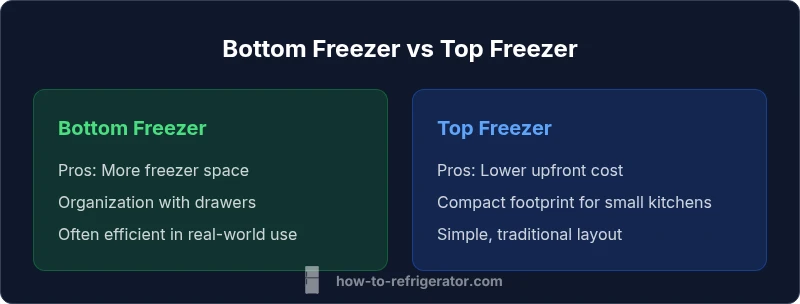
Bottom freezer refrigerators typically offer more freezer space and improved energy efficiency, while top freezers are usually cheaper and easier to access in tight spaces. For households with frequent frozen-storage needs and organized meal prep, a bottom freezer is often the better long-term value; for small kitchens or tighter budgets, a top freezer can be the more practical choice. This guide explains the key tradeoffs.
Key Differences at a Glance
Choosing between a bottom freezer and a top freezer refrigerator hinges on how you use your fridge and freezer, how much space you need for frozen items, and what fits your kitchen layout. In general, bottom freezers favor freezer space, energy efficiency, and organized storage, often with a drawer-style design that reduces the time items spend in cold air when you open the unit. Top freezers typically come at a lower upfront cost, offer straightforward access, and can be a solid choice for smaller kitchens or households with a modest frozen-food load. According to How To Refrigerator, the decision often boils down to freezer capacity versus upfront cost and kitchen footprint. The How To Refrigerator team found that many households with growing food-storage needs gravitate toward bottom-freezer models, while those prioritizing affordability or space constraints lean toward top-freezer configurations. This article uses practical benchmarks and real-world scenarios to help you quantify those tradeoffs and choose confidently.
Layout and Dimensions: How They Fit Your Kitchen
When evaluating fit, measure door swing clearance, cabinet depths, and any adjacent appliances. Bottom freezers are almost always taller if paired with a standard fridge above, and they demand a clear space for the drawer to open fully. The freezer drawer tends to be shallower but wider, which can improve visibility and reduce bending for many users. Top freezers, by contrast, typically present a taller, narrower profile with two doors or a single top-hinged door. This layout can be advantageous in narrow kitchens or alcoves where depth and door swing encroach on floor space. In both cases, check floor clearance and the ability to open doors without colliding with walls or cabinets. Consider also the hinge direction—refrigerator doors can be field-reversible on some models, which matters in smaller kitchens or unusual layouts. The choice should align with your wall measurements, doorway widths, and the typical traffic pattern in your kitchen.
Accessibility and Usability: Daily Routines
For many households, accessibility is the deciding factor. Bottom freezers require pulling out a drawer, which many users find more ergonomic once items are organized by category. A well-organized bottom freezer will keep frequently used items within easy reach and reduce time spent digging for items. Top freezers offer quick access to the most-used fridge items and a familiar, simple door operation. However, reaching items at the top of a stacked fridge column can be tiring for shorter users or those with limited mobility. In this section, we explore ergonomic considerations, including drawer height, pull handles, and interior lighting that can ease everyday use. As with any major purchase, test-drive the door swing and drawer action in a showroom or a trusted retailer before buying.
Capacity and Organization: Freezer vs Fresh Food
Capacity is not just about total cubic feet; it’s about how that space is organized. Bottom freezers typically maximize frozen storage with drawer systems and vertical dividers, which can improve visibility and reduce frost buildup in some models. This organization translates into better meal-prep workflows, longer-term storage feasibility, and easier inventory management for larger households. Top freezers usually allocate more space to the refrigerator compartment, which suits families that prioritize fresh produce and beverage storage. If you regularly stock bulk frozen items or prepare meals in advance, a bottom freezer can offer meaningful benefits in day-to-day use. If your freezer needs are occasional, a top freezer may be sufficient and allow more fridge capacity at a lower upfront cost.
Energy Efficiency and Operating Costs
Energy efficiency is influenced by model design, insulation, door seals, and compression technology, not merely by freezer position. In practice, bottom freezers with drawer configurations tend to minimize cold-air loss when the freezer is accessed, which can enhance efficiency in many setups. However, some top-freezer models also excel in efficiency, especially when they use advanced compressors and improved door insulation. For homeowners, the key is to compare ENERGY STAR certified models within the same size class rather than assuming one configuration is universally better. Over time, even modest differences in efficiency can accumulate into meaningful savings on electricity bills.
Maintenance, Reliability, and Long-Term Value
Maintenance needs differ by design. Drawer-based bottom freezers can accumulate frost in the drawer tracks if not cleaned regularly, but they are generally easier to wipe clean and organize. Top freezers often have simpler interior layouts, which can simplify parts replacement and routine cleaning. Reliability tends to track with overall quality and brand, rather than with freezer position alone. When evaluating options, look for solid door seals, good insulation, and reliable compressors. Regular maintenance, such as cleaning coils and checking gaskets, extends life for both configurations. If you live in a region with high humidity or frequent power outages, confirm that the model has a robust defrost system and an efficient startup sequence to protect frozen foods.
Real-World Scenarios and Buyer's Guides
Consider your household size, cooking style, and shopping habits. If you regularly stock large quantities of frozen foods, a bottom freezer can simplify organization and accessibility. For apartment dwellers or buyers with a strict budget, a top freezer offers a compact footprint and lower upfront cost, with adequate fridge space for daily needs. Think about your peak usage times: if you do most cooking on weekends with big prep sessions, the extra freezer capacity can be invaluable. If you primarily rely on fresh foods and pantry staples, you may value fridge space more than freezer capacity. Use this framework to compare specific models side by side, including dimensions, energy ratings, and warranty terms.
Authoritative Sources and Further Reading
To deepen your understanding beyond experience, consult reputable sources:
- Energy.gov: Refrigerators and energy efficiency overview
- ENERGY STAR: Refrigerators product page and efficiency tips
- Consumer Reports: Top-freezer vs bottom-freezer performance analyses
- How To Refrigerator Analysis, 2026: Contextual guidance on model selection and long-term value
According to How To Refrigerator, the choice is not a single best option; it depends on your space, routine, and budget. The guidance here helps translate those factors into actionable criteria for a confident purchase.
How to Decide: Quick Checklist
- Confirm kitchen dimensions and door swing clearance for both configurations.
- Estimate your weekly freezer usage (bulk storage vs. daily ice-and-veg needs).
- Compare energy ratings and hardware quality across models in the same price tier.
- Assess maintenance requirements and warranty coverage before buying.
- Prioritize ergonomics for household members with mobility considerations. A thoughtful measurement and test-drive can prevent a costly mismatch later.
Comparison
| Feature | bottom freezer | top freezer |
|---|---|---|
| Door configuration | Drawer-style bottom freezer; fridge above | Top freezer with freezer door on top; fridge below |
| Usable freezer space | Typically larger due to drawer layout and better use of vertical space | Usually smaller freezer section, with more fridge space |
| Daily usability | Often easier to access frozen items without bending if organized well | Fridge items are generally easier to reach at standing height |
| Energy efficiency | Can be highly efficient when well-designed with drawers and good seals | Efficiency varies by model; strong options exist among top-freezer lines |
| Initial price | Typically higher upfront cost for bottom-freezer models | Often lower upfront cost for top-freezer models |
| Best for | Families needing freezer capacity and organized storage | Budget-conscious buyers and small kitchens |
Strengths
- Bottom freezers maximize freezer space with organized drawers
- Top freezers are usually more affordable upfront
- Both configurations can be energy efficient in modern models
- Door seals and insulation quality matter more than freezer position
Cons
- Bottom freezers may be heavier to pull and require more bending for some items
- Top freezers can offer less freezer space despite a larger fridge section
- Availability of parts and repair services can vary by brand and model
- Choosing a non ENERGY STAR model can raise long-term energy costs
Bottom freezer wins for capacity and long-term efficiency; top freezer wins for budget and compact spaces
If you need substantial frozen storage and organized access, choose bottom freezer. If you're constrained by space or price, a top freezer remains a sensible, value-focused option.
FAQ
What is the main difference between bottom freezer and top freezer refrigerators?
The primary distinction is the location of the freezer: bottom freezers sit at the bottom with a drawer, while top freezers are at the top with the fridge below. This layout affects capacity, access, and ergonomic use depending on your kitchen and daily routines.
The main difference is where the freezer sits: bottom or top. It changes how you access frozen versus fresh items and can affect space and ergonomics.
Which is more energy efficient between the two?
Energy efficiency depends on the model rather than position alone. Many bottom freezers use drawers that minimize cold-air loss; many top freezers also achieve high efficiency with modern compressors and insulation. Compare ENERGY STAR ratings within the same size class for a fair assessment.
Efficiency varies by model. Look at ENERGY STAR ratings within the same size to compare fairly.
Are bottom freezers better for larger households?
Yes, for households that stock ice, bulk frozen meals, or frequent batch freezes, bottom freezers typically offer more usable storage and easier organization. If your family mostly uses fresh foods, the fridge space and simplicity of a top freezer might be more important.
They’re generally better for big frozen-storing needs, but if you mostly use fresh foods, a top freezer can work well too.
What should I consider for a small kitchen?
In tight spaces, top freezers often fit with a shorter footprint and simpler door configurations. If you can accommodate a bottom freezer with the right layout and you value freezer capacity, measure carefully and consider a compact bottom-freezer model.
In small kitchens, a top freezer can save space, but check the footprint and door clearance before buying.
How about maintenance and repair for each type?
Maintenance needs are similar across both configurations and depend more on brand quality and model design. Regular coil cleaning, door-seal checks, and prompt attention to unusual noises help extend life for either type. Verify warranty terms and the availability of service from local technicians.
Maintenance is similar for both. Keep seals clean and coils dust-free; check warranty coverage.
Is one type more affordable to buy than the other?
Top freezers generally have lower upfront prices on many models, while bottom freezers can cost more initially due to drawer designs and larger overall freezer space. Long-term electrical costs depend on efficiency and usage rather than solely on freezer position.
Top freezers usually cost less upfront; bottom freezers can cost more but offer more freezer space and potential savings over time.
Top Takeaways
- Evaluate freezer capacity vs fridge capacity based on your usage
- Measure kitchen space and door clearance before buying
- Prioritize ENERGY STAR models within your price tier
- Test door/drawer operation in-store to confirm comfort
- Consider long-term operating costs alongside upfront price