Refrigerator vs Heat Engine: A Practical Comparison for Homeowners
Compare refrigerators and heat engines for homeowners: how they work, efficiency concepts, and practical maintenance tips to save energy and extend appliance life.


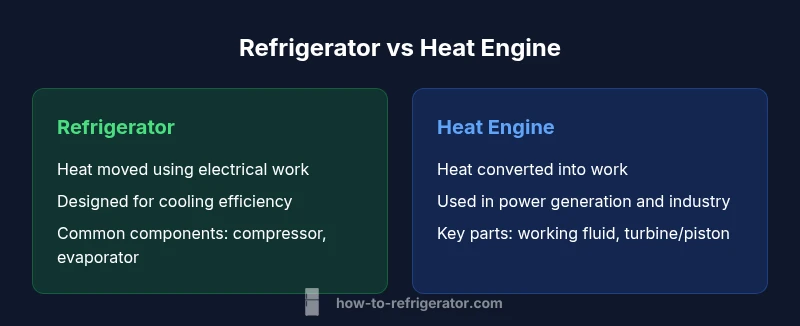
Refrigerators and heat engines operate on opposing thermodynamic principles: refrigerators move heat from a cooler interior to a warmer exterior using electrical work, while heat engines convert heat from a high-temperature source into useful work. For homeowners, this distinction explains why fridges consume energy differently than engines used to generate power, and it informs maintenance, energy labels, and troubleshooting decisions.
Fridge Fundamentals: How a Refrigerator Works vs a Heat Engine
In everyday homes, the phrase refrigerator vs heat engine highlights two foundational ideas in thermodynamics. According to How To Refrigerator, understanding these concepts helps homeowners interpret energy labels, diagnose cooling problems, and make smarter fixes. A refrigerator is a heat pump that uses electrical energy to move heat from a cold interior to a warmer exterior. It consumes work to relocate heat rather than to generate it. By contrast, a traditional heat engine takes in heat from a high-temperature source and converts part of that heat into useful work, with the rest released to the environment.
The practical upshot for homeowners is this: a refrigerator's job is to keep foods cold while consuming energy efficiently; a heat engine's job is to produce work from a heat source in industrial settings or power generation. In both cases, the underlying thermodynamics rely on cycles, pressures, and working fluids, but the direction of heat flow and the target outcome are opposite. Real-world refrigerators optimize the cycle to minimize energy waste, while heat engines aim to maximize work output within the limits set by the second law of thermodynamics. Understanding these distinctions helps you set expectations for energy bills, maintenance tasks, and troubleshooting steps.
Key Thermodynamic Principles in Plain Language
The refrigerator-heat engine comparison hinges on a few core ideas that homeowners can grasp without calculus:
- Heat moves from hot to cold naturally; to move heat uphill (into a warmer space), you must supply external work. A refrigerator does this to remove heat from the interior; a heat engine does the opposite, turning part of the heat into usable work.
- The efficiency metric differs: refrigerators use a Coefficient of Performance (COP) to describe cooling efficiency, while heat engines use thermal efficiency to describe how much of the input heat becomes work. These concepts are model- and condition-dependent.
- Real devices are non-ideal. Leaks, frayed seals, aging compressors, and non-ideal fluids reduce COP or efficiency. Your goal as a homeowner is to maximize the useful cooling you obtain per unit of energy, while recognizing practical limits of the machine you own.
Common Configurations and How They Differ in Construction
A refrigerator comprises a closed loop with an evaporator, condenser, compressor, and expansion device. The system shifts heat from the interior to the exterior by compressing a refrigerant, then expanding it to absorb heat at low temperature. A heat engine, by contrast, involves a working fluid that absorbs heat from a high-temperature source, expands or moves through a cycle to produce mechanical work, and then rejects heat to a sink. The key takeaway for homeowners: a refrigerator’s design is optimized for moving heat with minimal energy, whereas a heat engine’s design prioritizes converting heat into work, often at larger scales.
As a homeowner, you’ll notice the practical differences in components, maintenance requirements, and noise profiles. Refrigerators frequently feature electronics for temperature control and anti-flood defrost cycles, while heat engines (in industrial or automotive contexts) emphasize robust turbines or piston-based systems. Understanding these construction distinctions helps when interpreting service manuals, energy labels, and fault codes.
Real-World Implications for Homeowners
For most readers, the relevance lies in energy use, cost, reliability, and space planning. Refrigerators are designed for long, quiet, energy-efficient operation, with attention to door seals, insulation, and refrigerant integrity. Heat engines found in home contexts are generally part of larger systems (like HVAC power generation) and come with different maintenance schedules and safety considerations. When you compare refrigerators to heat engines conceptually, you gain insight into COP versus thermal efficiency, why a fridge might run continuously on a hot day, and how environmental factors affect performance. The bottom line is: the more closely a homeowner understands these principles, the better they can troubleshoot cooling problems, choose energy-efficient models, and plan for future upgrades.
How to Diagnose Refrigeration vs Heat Engine Issues
Diagnosing issues begins with a clear symptom set. If a device is cooling poorly, check the interior temperature, door seals, and condenser coils for cleanliness. Listen for unusual noises and assess vibration or cycling patterns. For devices described as a “heat engine” in non-home contexts, you’ll examine heat sources, exhaust conditions, and mechanical integrity of moving parts. In both cases, verify that controls are calibrated correctly and that refrigerants (for refrigerators) or working fluids (for engines) are not leaking or degraded. When in doubt, consult the service manual or a qualified technician who can diagnose based on model-specific data rather than general assumptions.
Practical Experiments You Can Run
You can perform simple, safe checks at home to understand how your system behaves. Use an energy monitor to observe baseline energy use over a typical cycle without relying on spec sheets alone. Record interior temperatures during a load of groceries and compare them to ambient temperatures, noting how quickly heat is transferred out of the interior. If your fridge has a defrost cycle, observe the pattern and verify that it defrosts without excessive frost buildup. For larger systems that you suspect operate as a heat engine, confirm that heat input is directed toward the intended work output and that heat rejection paths are unobstructed. These practical experiments help you quantify performance in real-world terms.
Common Myths and Misconceptions
A frequent misconception is that all cooling devices are “heat engines” in the same sense. In reality, refrigerators are heat pumps operating with a reversed heat engine concept. Another myth is that bigger is always better; in truth, capacity must match usage, and efficiency often improves with proper sizing and installation. Some homeowners assume that any energy-efficient label guarantees low operating costs—labels reflect performance under test conditions, not your daily usage. Finally, people sometimes think maintenance is only about cleaning coils; sealing, insulation, and electronics also impact COP and reliability.
Efficiency Trends and Future Outlook
The field is moving toward smarter controls, variable-speed compressors, and refrigerants with lower global warming potential. Homeowners may notice longer-lasting seals, better insulation, and quieter operation as these trends mature. While the physics of heat transfer remains the same, advances in sensors, firmware, and system integration help appliances respond to real-world conditions more efficiently. Understanding these trends helps you anticipate future upgrades that can improve comfort, reduce energy use, and lower operating costs over the life of the appliance.
Quick Troubleshooting Guide: When to Call a Pro
If you notice persistent poor cooling, abnormal noises, or frequent cycling, start with a basic inspection of seals, coils, and door alignment. If simple fixes don’t restore performance, consult the manufacturer’s guidance or a licensed technician. For larger systems or devices described as “heat engines” in specialized equipment, schedule professional maintenance to assess calibration, lubrication, and safety considerations. Quick, early intervention often prevents more expensive repairs and extended downtime.
Summary of Design Trade-offs
Designing a cooling device versus a power-producing engine involves balancing energy use, performance, reliability, and cost. Refrigerators prioritize steady, low-energy cooling with integrated controls and defrost strategies, while heat engines emphasize maximizing work output and enduring heat flow management. Homeowners benefit from recognizing these trade-offs when selecting appliances, scheduling maintenance, and planning upgrades. The right choice depends on your household needs, energy goals, and long-term budget.
The Big Picture: Why It Matters for Your Home
Understanding refrigerator vs heat engine concepts helps homeowners interpret energy labels, plan energy-saving upgrades, and approach maintenance with a clear framework. It supports better decision-making about repairs, component selection, and overall energy strategy. By aligning expectations with thermodynamic realities, you can keep your kitchen running smoothly while avoiding unnecessary expense and waste. The ongoing goal is to maximize comfort and reliability through informed choices.
Comparison
| Feature | Refrigerator | Heat Engine |
|---|---|---|
| Operating Principle | Moves heat from interior to exterior using electrical work | Converts heat into mechanical work (power output) |
| Energy Source | Electrical power from grid or local supply | Combustion heat or other heat source plus working fluid |
| Efficiency Metric | COP (coefficient of performance) for cooling | Thermal efficiency (eta) for work output |
| Common Components | Compressor, evaporator, condenser, expansion device | Hot source, working fluid, turbine or piston, heat sink |
| Typical Noise Profile | Low to moderate, depending on model and age | Higher in some configurations due to moving parts |
| Maintenance Focus | Seal integrity, coils cleaning, refrigerant health, door alignment | Lubrication, seals, and moving parts; calibration |
| Typical Applications | Residential cooling, food preservation, climate control in homes | Power generation, process heat, or laboratory/industrial uses |
Strengths
- Clarifies fundamental thermodynamics for homeowners
- Aids energy-based decision making and troubleshooting
- Supports better model selection for energy efficiency
- Helps distinguish cooling needs from power generation contexts
Cons
- Conceptual topic that can feel abstract to non-engineers
- Context matters; not all homes interact with heat engines
- Direct applicability to fridge fixes is limited
- Differences can be subtle in everyday observations
Understanding the refrigerator-heat engine contrast clarifies energy decisions
For homeowners, focus on COP for cooling devices and on maintenance practices. When considering engines, evaluate heat input quality and safety. The key is applying thermodynamics to practical fixes and upgrades.
FAQ
What is the main difference between a refrigerator and a heat engine?
A refrigerator uses electrical work to move heat from inside to outside, effectively cooling a space. A heat engine converts heat from a source into usable work, producing energy rather than cooling. The two are thermodynamic opposites in terms of heat flow direction and goal.
A refrigerator uses electricity to move heat out of your fridge; a heat engine converts heat into work. They’re opposite in purpose and heat flow.
Can a refrigerator ever be used as a heat engine?
In principle, the same physical laws apply, but a household refrigerator is not designed to function as a power generator. It moves heat efficiently, whereas a heat engine purposefully converts heat into work and requires different components and safety considerations.
Not typically. A fridge is designed to cool, not to generate power, though the underlying thermodynamics share common principles.
What does COP mean and why does it matter for homeowners?
COP stands for coefficient of performance. It measures how effectively a cooling device moves heat per unit of energy used. A higher COP means better energy efficiency for a refrigerator or heat pump, which translates to lower operating costs.
COP tells you how efficiently a cooling device uses energy. Higher COP = lower bills and less wasted energy.
Are there home appliances that combine heating and cooling with a heat engine?
Some HVAC systems and heat pumps perform heating and cooling, guided by the same thermodynamic principles as a refrigerator. They are not, however, engines that produce work for consumer use; they are integrated systems designed to move heat for comfort and efficiency.
There are systems that heat and cool, but they aren’t power-generating engines for consumer use.
What maintenance tips help maximize refrigerator efficiency?
Keep door seals clean and undamaged, minimize door openings, clean condenser coils regularly, and ensure proper airflow around the appliance. Correct thermostat settings and defrost schedules also help maintain optimal COP.
Keep seals clean, don’t over-open the door, and dust coils to keep efficiency high.
Is it realistic to compare your fridge to a heat engine in the home?
Yes, as a conceptual comparison it clarifies why refrigerators cool versus how engines generate work. Practically, most homeowners should focus on maintenance, energy labels, and proper sizing rather than treating a fridge as a power generator.
It’s a helpful concept, but remember to focus on cooling performance and energy use for everyday homes.
Top Takeaways
- Understand COP vs thermal efficiency
- Match appliance type to home energy goals
- Prioritize seals, coils, and controls for efficiency
- Use real-world tests to validate performance
- Plan upgrades with long-term energy savings in mind