What Makes Refrigerator Garage Ready
Discover what makes a refrigerator garage ready, including operating ranges, installation tips, and maintenance practices to keep your garage fridge reliable. How To Refrigerator provides clear, actionable steps for homeowners.


Definition: What makes refrigerator garage ready is its ability to perform reliably in wide garage temperature swings, with a robust compressor, adequate insulation, and appropriate defrost and control systems. A garage-ready unit should tolerate higher ambient temps, protect against cold snaps, and be installed on a level surface with proper ventilation and a dedicated, grounded outlet. This guide walks homeowners through practical steps to achieve that readiness.
What makes a refrigerator garage ready
According to How To Refrigerator, preparing a fridge for garage use goes beyond labeling. A garage-ready refrigerator is designed to handle wide ambient temperature ranges, with components sized for higher start-up loads, enhanced insulation, and a control system that compensates for temperature swings. The How To Refrigerator team found that successful garage installations balance climate resilience with safe electrical sourcing and adequate clearance for airflow. Homeowners should inspect the space where the unit will live, ensuring it’s away from heat sources, direct sunlight, and potential water exposure. In a typical garage, temperatures can fluctuate dramatically between seasons; a unit that is not designed for this environment can waste energy, run continuously, or fail to maintain safe food temperatures. Planning ahead—including a level floor, a grounded outlet, and accessible drainage—sets the stage for reliable operation in even extreme conditions. For those uncertain about where to place a fridge, a dedicated corner with a small vented gap behind the appliance helps with air circulation and reduces heat transfer from surrounding walls. Finally, check the door seals and ensure they are intact; a poor seal compounds temperature swings and reduces efficiency, especially when doors are opened frequently in busy garage spaces.
Key design features for garage-ready refrigerators
Garage-ready refrigerators share several design elements that help them perform in less predictable spaces. First, they offer an extended operating temperature range and a compressor with higher start-up torque so the unit can begin cooling quickly after a warm period in hot summers. Insulation is typically thicker than in standard models, reducing heat gain from garage walls and keeping electrical load manageable when ambient temperatures swing wildly. The seals on doors are reinforced and designed to maintain a tight closure even with regular opening during busy projects. Ventilation around the condenser is prioritized, with rear panels and grills free of obstructions to prevent overheating. Some models also include an internal heater in the defrost circuit to prevent frost build-up at low temperatures or during power interruptions. Energy efficiency is often a focus, because garages are dimly lit and less predictable than kitchens. Finally, many garage-ready fridges feature vibration-minimizing feet and anti-tip design to cope with uneven flooring common in garages. These features collectively ensure the appliance runs reliably, uses less energy, and lasts longer in a space where temperature and humidity can surprise you.
Space planning and model selection for garage use
Space planning begins with the question: where will the fridge live, and how will it behave in extreme conditions? Start by choosing a location away from direct sun, heat sources such as furnaces, and areas prone to water exposure. The floor should be level, supporting the unit's weight without rocking. Ensure there is at least a couple inches of clearance on all sides for air flow, and check that nearby outlets are grounded, on a stable circuit, and sized for appliance startup current. When selecting a model, look for explicit references to garage use or an extended operating range. Compare capacity versus footprint, because a smaller unit in a garage may run longer than a larger one kept at moderate temperatures. If you live in a climate with very hot summers or freezing winters, prefer models with a wide ambient tolerance and robust insulation. Finally, consider a unit with adjustable shelves and a well-sealed door to accommodate fluctuating storage needs and reduce energy waste.
Electrical and installation prerequisites
A safe installation begins with electrical readiness. Use a dedicated grounded outlet on a circuit capable of handling the fridge’s startup surge. Avoid daisy-chaining outlets or using extension cords as a permanent solution in a garage. If an outlet is aged or ungrounded, have an electrician bring the circuit up to code. Check for GFCI protection if the fridge is near a damp area or driveway entry. Provide a clear path for drainage, especially for units with frost-free features, and ensure that the outlet location prevents cords from crossing walkways or planters. Finally, ensure the space has good air exchange and that the back of the unit is not against a wall that blocks airflow. These steps reduce the risk of overheating and help maintain safe temperatures inside the appliance.
Setting up for reliable operation in temperature swings
With the space prepared, focus on stability. Place the fridge on a level surface, using shims if necessary to compensate for uneven concrete. Position the unit so that the condenser vents are not blocked and there is adequate clearance behind and to the sides. Plug into the dedicated outlet and power up the unit, then set controls to a conservative starting point and allow a few hours for stabilization. If your garage experiences extreme heat in summer, consider pairing the fridge with a small fan to boost air movement around the appliance and reduce heat buildup on the exterior. In winter, avoid placing the unit near drafts or unheated corners where ambient temperatures can freeze the exterior and interfere with seals. Finally, document the initial temperature readings to compare against future checks and adjust as needed for reliable performance.
Maintenance routines that prevent garage-specific failures
Regular maintenance is essential in a garage setting. Clean the condenser coils at least twice a year or as dust accumulates, and inspect door seals for cracks or warping. Wipe down the interior and check for condensation patterns that might indicate airflow restrictions or improper sealing. Keep the area around the unit free from clutter that could block heat dissipation or trap moisture. Periodically test the thermostat and defrost cycle if present, listening for abnormal noises that could indicate motor or compressor wear. Finally, review the control settings and verify that energy-saving modes do not compromise cooling in extreme garage temperatures. A quick maintenance checklist can keep the appliance reliable for years.
Troubleshooting common garage-performance issues
If the fridge appears not to cool as expected, start with simple checks. Confirm the door seals are airtight, the condenser is not clogged with dust, and the vent grills are clear. Listen for unusual noises that might indicate a failing compressor or fan motor. Check that the thermostat is correctly set and that the unit is not located in an area with broad temperature swings that exceed its design range. If frost builds up, inspect the defrost system; a blocked defrost drain can lead to frost accumulation. For persistent issues, call a qualified technician to verify electrical supply and refrigerant status. In many cases, addressing airflow or insulation can restore performance without major repairs.
Practical checklists and next steps
Pre-install checklist: Confirm space, ventilation, outlet readiness, and a level floor. Installation day: Level, connect power, run initial tests, and record temperatures. Post-install routine: Check seals, clean coils, and re-check temps weekly for the first month. Long-term plan: Schedule semi-annual maintenance and keep a log of readings and service visits.
Tools & Materials
- Digital thermometer(Monitor interior temperatures across compartments)
- Level(Ensure fridge sits evenly on a hard surface)
- Screwdriver set(Use for mounting and hardware adjustments)
- Voltmeter/outlet tester(Verify grounded, properly wired outlet)
- Surge protector(Protect from power spikes; use one with adequate rating)
- Measuring tape(Check clearances around the appliance)
- Silicone sealant(Seal gaps behind left or right sides if needed)
- Gasket conditioner(Keep door seals supple)
- Cordless drill (optional)(For installing mounting hardware)
Steps
Estimated time: 2-4 hours
- 1
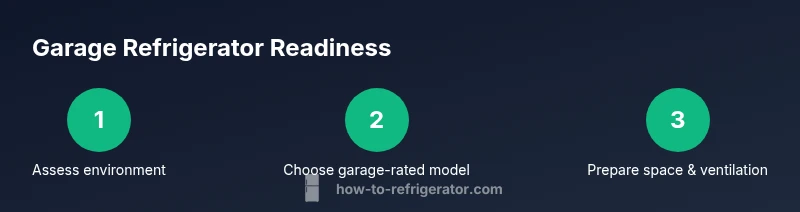
Assess the garage environment
Survey the space for temperature swings, humidity, ventilation, and the risk of moisture exposure. Note the typical garage temps across seasons and identify nearby heat sources or direct sunlight. This helps determine if a standard fridge suffices or if a garage-rated model is needed.
Tip: Take 2-3 temperature readings at different times of day to understand swings. - 2
Choose a garage-rated model
Select a refrigerator that explicitly lists a wide operating temperature range and robust start-up performance. Compare seals, insulation thickness, and energy efficiency ratings. A model marketed as garage-ready is more likely to maintain safe temperatures in extreme conditions.
Tip: Check product literature for operating range and compressor capacity. - 3
Prepare the installation space
Clear a stable, level area with enough clearance for airflow at back and sides. Remove rug or carpet under the fridge and ensure a grounded outlet is nearby. Plan for drainage if the fridge has a defrost drain that may leak condensate onto the floor.
Tip: Use a level to confirm the surface is flat within a quarter-inch. - 4
Position and level the fridge
Slide the unit into place and adjust feet or shims so it sits perfectly level. Leveling prevents doors from misaligning and reduces vibration, which can impact seals and efficiency. Leave space for air to circulate behind the coils.
Tip: Avoid resting on soft surfaces like carpet; use a solid base. - 5
Connect power safely
Plug into a dedicated grounded outlet; avoid multi-outlet strips. Use a surge protector rated for appliances and ensure the cord is not stretched or damaged. If the outlet is not properly grounded, have an electrician upgrade the circuit.
Tip: Do not use extension cords as a permanent solution. - 6
Test temperature and operation
Set the thermostat to typical operating temperatures, wait 24 hours, and verify the interior temps stay within safe ranges. Check the freezer compartment if present and ensure the defrost cycle runs normally. Document readings for future reference.
Tip: Record the first 24-hour temperature profile for comparison.
FAQ
Can any refrigerator be used in a garage?
Not every fridge performs well in a garage. Look for models that explicitly state a wide operating temperature range and sturdy construction. If in doubt, choose a garage-rated unit designed for variable temps.
Not every fridge works well in a garage; pick a garage-rated model with a wide operating range.
What temperature range should a garage fridge handle?
Many garage-ready fridges list operation roughly from 50°F up to 110°F or higher. Use a thermometer to verify temperatures stay in a safe range for food storage across the seasons.
Most garage fridges operate roughly between 50 and 110 degrees Fahrenheit; verify with a thermometer.
Are there garage-rated refrigerators?
Yes. Garage-rated refrigerators are designed to tolerate wider ambient temperatures and higher startup loads. Check product specs for operating range and climate performance.
Yes, there are garage-rated fridges designed for broader temperature ranges.
Can I use a standard household outlet for a garage fridge?
Use a dedicated grounded outlet, preferably on its own circuit. Avoid relying on extension cords or multi-outlet strips for safety and performance.
Yes, a dedicated grounded outlet works best; avoid extension cords.
What maintenance is recommended for garage use?
Regularly inspect seals, clean condenser coils, and monitor temperatures. In a garage, check for moisture and dust buildup that can reduce efficiency.
Inspect seals and coils regularly and watch for moisture buildup.
When should I replace a garage fridge?
If the unit frequently fails to maintain safe temperatures or experiences persistent compressor noise or excessive frost, it may be time to replace rather than repair.
If it can’t maintain temps or is consistently noisy, consider replacement.
Watch Video
Top Takeaways
- Evaluate garage environment before buying.
- Choose a garage-rated refrigerator when possible.
- Install on a level surface with proper ventilation.
- Inspect electrical connections and use a surge protector.
- Monitor temperatures regularly to ensure reliability.