French Door vs Side-by-Side Refrigerator: A Comprehensive Comparison
In-depth, objective comparison of French door and side-by-side refrigerators, covering layout, capacity, energy efficiency, costs, and maintenance to guide homeowners in choosing the best fit.


For homeowners deciding between a french door versus side by side refrigerator, the clear answer is: neither is universally best; your kitchen size, storage needs, and daily routine determine the winner. In this guide, we compare layout, capacity, accessibility, and costs to help you choose.
Understanding the French Door vs Side-by-Side Question
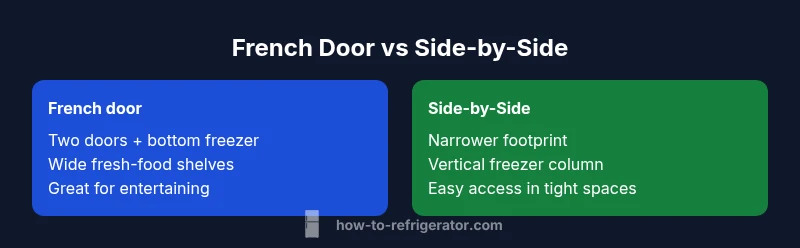
Choosing between a french door versus side-by-side refrigerator is not simply a matter of aesthetics. The decision shapes how you shop, stock, and move through the kitchen every day. In plain terms, one configuration tends to optimize fresh-food storage with wide doors and a bottom freezer, while the other prioritizes a narrower footprint with a tall, vertical freezer column. The How To Refrigerator team emphasizes that your layout, traffic patterns, and daily routines should lead the choice, not the opposite. According to How To Refrigerator, the critical factors are kitchen geometry (how wide the doors swing and how much clearance you have), your typical grocery load, and how often you access the freezer during peak cooking times. When you compare “french door versus side-by-side refrigerator,” you’re weighing access to produce versus quick freezer retrieval, and you’re balancing the look of the unit with the practical rhythms of your household. Real-world decisions hinge on these three pillars: space, usage, and budget. The How To Refrigerator Analysis, 2026 reinforces that framing, urging homeowners to map their routines to the door pattern before buying.
20words
Comparison
| Feature | French door refrigerators | Side-by-side refrigerators |
|---|---|---|
| Door configuration | French door: two vertical doors above a bottom freezer | Side-by-side: two tall doors with a vertical freezer column |
| Primary storage layout | Wide fresh-food shelves, deep door bins, and often a roomy deli/produce area | Tall vertical freezer with a large freezer section and narrower fresh-food area |
| Width and space requirements | Typically wider, requiring more overall kitchen width | Usually narrower, helpful for compact or galley kitchens |
| Best use case | Entertaining, open-plan kitchens, and high produce turnover | Narrow kitchens, easy access to frozen goods, and quick grab-and-go items |
| Energy efficiency considerations | Model-dependent; many high-efficiency options exist across both configurations | Model-dependent; efficiency varies by model but energy Star options are common |
| Maintenance and repairs | More complex door seals and hinges in some models; servicing can be costlier | Simpler door mechanism in many models; easier access for some repairs |
Strengths
- Expanded fresh-food capacity with wide shelves
- Easy access to main fridge without bending
- Flexible interior layouts and adjustable shelves
- Great for entertaining and open-concept spaces
- Potentially higher resale value
Cons
- Higher upfront cost on average
- Ice/water features can reduce usable door storage
- Takes more kitchen width; may not fit narrow spaces
- Maintenance costs can be higher for complex doors
French door is typically the better all-around choice for space and access in open kitchens; side-by-side excels in narrow layouts and quick frozen-item access
Choose French door if you prioritize fresh-food storage and a roomy, guest-friendly layout. Choose side-by-side if your kitchen is narrow and you want a compact footprint with easy access to frozen items. The best pick depends on your space and daily habits.
FAQ
What is the key difference between French door and side-by-side models?
The main difference lies in door configuration and storage focus. French doors emphasize wider fresh-food access with a bottom freezer, while side-by-side units prioritize a narrower footprint with a vertical freezer column. Both can be energy efficient if you choose Energy Star-rated models.
The key difference is door layout and storage focus: French doors give you broader fresh-food access, and side-by-sides save space while keeping a tall freezer.
Is one configuration better for small kitchens?
In tight spaces, side-by-side models often fit better due to their narrower width, while French door models can still work if you have a generous doorway clearance and an open floor plan. Consider door swing, cabinet depth, and clearance for open doors when planning.
If your kitchen is narrow, a side-by-side often fits better, but measure clearance for doors to swing fully.
Are French door refrigerators more energy-efficient than side-by-sides?
Energy efficiency varies by model rather than by configuration. Look for Energy Star ratings and compare annual energy usage on the label for both options you’re considering.
Depends on the model—check energy labels; both types can be very efficient if you pick the right model.
Do ice makers and water dispensers affect door storage?
Yes. Ice makers and water dispensers can reduce usable door storage space, especially on French-door units where the dispenser is mounted on one of the doors. Assess your needs for beverages and ice when evaluating capacity.
Dispenser features can cut into door storage, so plan around how often you use ice and water.
What should I consider about installation space and doors?
Consider the width of the doorway, the path to the kitchen, and whether doors will clear walls or cabinets when opened. Some kitchens require special installation due to door swing or hinge clearance.
Make sure you measure doorways and walking paths to avoid fitting problems.
Which configuration is easier to repair?
Repair ease is model-dependent rather than configuration-dependent. Generally, simpler hinge and seal systems may be easier to service on side-by-side units, but newer French-door models have reliable designs as well.
Repairs depend on the model; both can be reliable if you pick well-supported brands.
Top Takeaways
- Measure kitchen width and door swing before buying
- Prioritize fresh-food versus freezer needs based on family size
- Check Energy Star ratings for any configuration
- Evaluate water/ice features and where they sit in the door
- Budget for delivery, installation, and maintenance costs