Refrigerator Standard Sizes: What Homeowners Should Know
Discover refrigerator standard sizes, how to measure for fit, and compare configurations. Practical guidance for smarter kitchen planning and buying decisions.


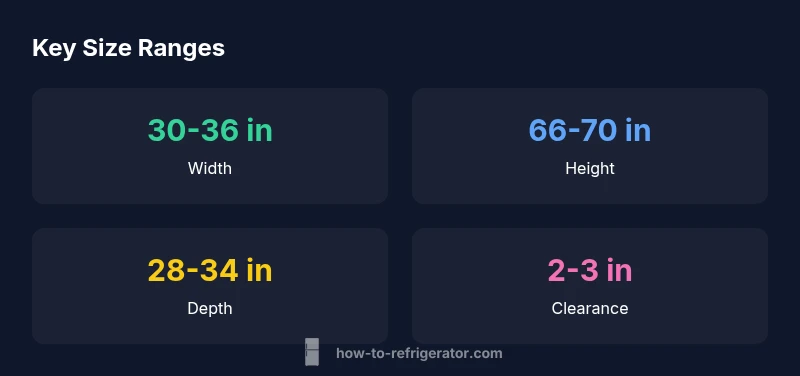
Common refrigerator widths range from 30 to 36 inches, heights from 66 to 70 inches, and depths of about 28 to 34 inches. These refrigerator standard sizes define fit in kitchen openings, door swing, and ventilation. Understanding these dimensions helps homeowners plan cabinetry, airflow, and installation before purchasing. According to How To Refrigerator, these ranges are designed to be a practical guide, not a rigid rule.
Understanding Refrigerator Standard Sizes
Refrigerator standard sizes aren't a single universal number; they describe a family of measurements that guide space planning in most homes. The How To Refrigerator team tracks these dimensions to help homeowners avoid buying a unit that won't fit a kitchen opening or will block doorway paths. The key dimensions are width, height, and depth. Width determines how wide the cabinet opening must be; height affects ceiling clearance and the usable vertical space above the hinge line; depth governs how far the unit protrudes from the wall and how the doors swing. In practice, you’ll see common ranges such as 30-36 inches in width, about 66-70 inches in height, and roughly 28-34 inches in depth, with some models extending a bit beyond those numbers. Within these ranges, configurations like top-freezer, bottom-freezer, side-by-side, and French-door each create different footprint implications. When planning, align your layout with the actual measured openings and consider airflow around coils and vents to maintain efficiency and prevent heat buildup near cooking zones. According to How To Refrigerator, these ranges are designed to be a practical guide, not a rigid rule.
How to measure for fit in your kitchen
Begin by measuring the cabinet opening width using a metal tape measure; record the widest point and note any irregularities in trim or crown molding. Next, measure the height from the finished floor to the bottom of the countertop or to the ceiling if the unit will be recessed above cabinetry. Depth requires measuring from the wall to the farthest protruding edge, including handles when closed. Don’t forget to account for clearance: add at least 2 inches of space behind the fridge for airflow and 1-2 inches on each side for door swing. If your space is odd-shaped, record multiple width/height combinations and compare them to model specs. Finally, verify the available plumbing and electrical clearances, ensuring there’s room for water lines, outlets, or ice-maker connections. This practical approach helps prevent mismatches and reduces the likelihood of professional installation surprises.
Width, height, and depth: what buyers actually compare
Shoppers often think only in width, but the best-fitting fridge balances all three dimensions. Width determines the fit between cabinets and walls; depth influences how far the door will extend into the room; height affects how it sits in relation to upper cabinets. When manufacturers advertise a model, you’ll see a trio of numbers (for example, 30 x 68 x 34): width, height, and depth. These numbers are typically presented with a tolerance of plus or minus a fraction of an inch, reflecting manufacturing variability and different measurement methods (inset doors vs. overlay doors, for instance). Interior volume is closely tied to these exterior numbers but isn’t a perfect predictor due to shelving and compartments. Finally, always compare the footprint to your actual space, not just a model’s advertised capacity; two fridges with the same width and height can offer different usable interior layouts.
Size expectations by configuration: top-freezer, bottom-freezer, side-by-side, French-door
- Top-freezer: Often the most affordable and compact option; typical widths are 30-32 inches, with heights around 66-69 inches and depths about 29-34 inches. This layout maximizes freezer space while keeping a shorter overall profile.
- Bottom-freezer: Combines higher refrigerator access with a freezer below; expect widths in the 30-33 inch range, heights near 66-70 inches, and depths around 29-34 inches. It’s a popular mid-size choice for families.
- Side-by-side: Prioritizes quick access to both compartments; widths usually 32-36 inches, heights 65-69 inches, and depths 28-34 inches. Wide doors can limit interior depth, so plan storage accordingly.
- French-door: Provides generous refrigeration with a wide footprint; typical widths 33-36 inches, heights 68-72 inches, depths around 30-36 inches. Requires ample kitchen width and solid door swing clearance to function well.
Integrating with cabinetry and doors: clearance and swing
Even within standard sizes, the door swing and cabinet door clearances determine whether a fridge can be installed flush with cabinetry. Plan for at least 2 inches of clearance on the sides and back, plus extra for door handles and hinge movement. If your kitchen has full-height cabinetry, you may need to shift the appliance into a dedicated toe-kick area or allow a small gap to accommodate the hinge arc. For built-in or panel-ready models, ensure the face frame and cabinet side panels align with the appliance, which can affect overall depth. Finally, confirm that the refrigerator’s door swing does not interfere with nearby appliances, ovens, or pantry doors; a few inches of buffer can prevent performance issues and make daily use more comfortable.
Real-world planning: spaces and ventilation clearance
In real kitchens, you’ll often find that space availability is the limiting factor, not the unit itself. Ventilation is critical: coils and condenser areas need airflow to operate efficiently, especially in hot climates or open-plan layouts. Plan for a minimum of 1-2 inches around the sides and a few inches behind the unit to prevent heat pockets and to facilitate maintenance access. If a wall is close to the fridge, consider a model with a shallower depth or a door that can be configured to minimize protrusion. Check floor-level interfaces such as baseboards or trim that might impede installation. If you’re moving a fridge across a room during a remodel, protect the floors and check for levelness after placement; even small tilts can affect door alignment and seal performance.
How manufacturers define standard sizes: tolerances and variations
Manufacturers use tolerances that account for production variance and installation differences. A 2-3 inch difference in depth between models with the same nominal footprint is not unusual, and some brands offer slightly more compact depths for kitchen renovations or built-in configurations. Heights can also vary by model line due to venting requirements or grille placement. Some configurations, such as counter-depth models, sit closer to the cabinet face, which changes both visual alignment and the usable interior depth. Finally, measurement methods (door-open position vs. closed, exterior handle projections) can lead to slightly different numbers across websites; always cross-check the official spec sheet and consider measuring your own space before purchasing.
Budget considerations: how size impacts energy use
While larger refrigerators generally provide more storage, they don’t always translate to higher energy costs. Energy efficiency ratings and interior organization can offset size-based energy differences. For households with infrequent use or smaller families, choosing a compact configuration and focusing on energy-star-rated performance can reduce annual consumption. Conversely, busy households with high-volume storage may justify larger footprints if the model offers features that improve cooling performance and reduce energy waste, such as better insulation, variable speed compressors, and smart defrost controls. In all cases, compare models within the same configuration range to ensure you’re weighing similar options when assessing energy use and operating cost. How To Refrigerator’s guidance emphasizes the importance of aligning energy efficiency with your real usage patterns.
Quick sizing checklist for your kitchen renovation
- Measure all openings and doorways; record clearances.
- List your top configurations (top-freezer, French-door, etc.) and their footprint ranges.
- Check the installed depth of existing cabinetry, especially if you plan a built-in look.
- Confirm door swing clearance and adjacent appliance access.
- Verify venting, coils access, and back clearances for airflow.
- Use the data table and sizing charts to shortlist models before visiting showrooms or browsing online.
- Double-check water lines and electrical outlets are positioned to match your chosen model’s connections.
- Always account for extra space for maintenance and seasonal airflow checks.
Sizing ranges by fridge configuration
| Config | Typical Width | Typical Height | Typical Depth | Notes |
|---|---|---|---|---|
| Top-freezer | 30-32 inches | 66-69 inches | 29-34 inches | Common in apartments and smaller kitchens |
| Bottom-freezer | 30-33 inches | 66-70 inches | 29-34 inches | Popular mid-size choice |
| Side-by-side | 32-36 inches | 65-69 inches | 28-34 inches | Wide frontal access, less interior depth |
| French-door | 33-36 inches | 68-72 inches | 30-36 inches | Large capacity |
FAQ
What are refrigerator standard sizes?
Standard sizes refer to common width, height, and depth ranges used by most brands. They help buyers plan fit, as well as clearance and ventilation.
Standard sizes are the typical widths, heights, and depths brands use; they help you plan fit and clearance.
How do I measure my kitchen for a new fridge?
Measure cabinet openings, door swings, and floor-to-ceiling height. Record width, height, and depth limits, and add extra space for door clearance and airflow.
Measure openings and add clearance for doors and ventilation.
Do all brands follow the same widths?
Most brands use similar width ranges, but exact measurements vary by model and configuration. Always check the spec sheet.
Brands are similar but not identical; always check the model specs.
What size is best for a small kitchen?
For small kitchens, compact or 24-28 inch-wide units with efficient layouts maximize space while preserving capacity.
In small kitchens, choose compact models with efficient layouts.
Does built-in cabinetry affect size?
Yes. Built-in or integrated setups often require shallower depths or custom fronts to match cabinetry.
Yes, built-ins can require special depth or flush-front designs.
How much clearance is needed around a fridge?
Allow at least 2-3 inches of clearance on the sides and back for ventilation and door swing.
Give a couple inches around the fridge for airflow and doors.
“Sizing is the first and most important step in choosing a refrigerator that fits your kitchen and lifestyle.”
Top Takeaways
- Measure space before shopping for a fridge
- Know width, height, and depth ranges
- Account for door swing and ventilation
- Size often affects storage layout and energy use
- Verify clearance with your cabinetry and plumbing