Discount Refrigerator Water Filters: Smart Savings With Safe Choices
Learn how to save on fridge water filters without sacrificing safety. This How To Refrigerator guide covers certifications, buying tips, and maintenance for 2026.


Discount refrigerator water filters can lower your long-term costs if you choose certified, compatible cartridges from reputable retailers. The best approach is to verify NSF/ANSI certifications, model compatibility, and return policies before buying, then flush the new filter to activate proper filtration. This balance of price and safety helps homeowners save without compromising water quality.
Understanding discount refrigerator water filters
Discount refrigerator water filters are replacement cartridges sold at reduced prices, often through third-party brands or retailer promotions. They’re designed to fit common refrigerator makes and models, and they can be a smart way to lower long-term maintenance costs — but price alone is not a guarantee of safety or performance. When you see a deal on filters, you still need to verify certification, compatibility, and the overall value you’re getting.
According to How To Refrigerator, the term discount refrigerator water filters usually refers to aftermarket cartridges that claim compatibility with many standard filter housings. The critical questions to ask are: Does this filter carry a certified filtration standard (such as NSF/ANSI 42 or 53)? Will it physically fit your unit’s filter housing and water line? Is there a credible warranty or return policy if it doesn’t perform as expected? Skipping these checks can turn a bargain into a water-quality risk, especially if your family relies on purified water for daily use.
To set expectations, remember that the cheapest option is not always the best. Some low-cost filters may be counterfeit or poorly sealed, which can lead to leaks or reduced filtration. You’ll often find a wide price spectrum: some legitimate aftermarket filters are priced similarly to OEM cartridges, while others are deeply discounted during sales events. The key is to combine thoughtful evaluation with practical buying habits, such as sticking to recognized retailers and checking the packaging for certification marks.
Evaluating savings vs. risk when buying cheap filters
When you’re weighing discounted options, calculate the true cost per filtered serving rather than just the sticker price. Start by identifying how many months a cartridge is expected to last in your household usage, then divide the price by that lifespan to get a monthly cost. If you’re buying a multi-pack, estimate how many months that pack will cover and compare it against buying individual OEM cartridges. For example, a two-pack priced at twenty-five dollars that yields two filters lasting six months each translates to roughly two hundred weeks of filtration across a year, which may still be cost-effective if the filters meet standards.
Beyond price, consider reliability and safety. Read customer reviews focusing on filtration performance, leaks, and any odor or taste issues after installation. Verify that the filters you’re considering carry an NSF/ANSI certification and a credible warranty. Finally, account for potential hidden costs like shipping, return shipping, or restocking fees when comparing sellers. How To Refrigerator Analysis, 2026 shows that savvy buyers look for total ownership cost rather than upfront price alone, and they favor retailers with transparent return policies and clear compatibility information.
Certifications that matter for discount refrigerator water filters
Not all discount filters are created equal. The most important safeguard is certification from independent bodies. Look for NSF/ANSI 42 for taste and odor reduction, NSF/ANSI 53 for lead and chemical contaminants, and, if relevant, NSF/ANSI 401 for emerging contaminants. Some filters also advertise performance improvements like chlorine taste and odor reduction or reduced sediment. The packaging should display the NSF mark with the certification number clearly visible. If you’re unsure, check the model compatibility list published by the refrigerator manufacturer and compare it to the cartridge’s stated compatibility. A properly certified, model-matched filter provides confidence that you’re not compromising water quality for a lower price.
According to How To Refrigerator Analysis, 2026, filters that lack credible certification or a compatibility guarantee are a red flag. Even the best price can backfire if a filter fails to fit your housing or leaks into the dispenser. Always confirm the exact model number of your fridge and cross-check it against the filter’s compatibility notes before purchase.
Buying guide: where to shop for discounts safely
Smart shoppers combine price awareness with safety checks. Start at official brand sites or the original manufacturer’s recommended retailers to ensure part compatibility and return options. Major home improvement stores and well-known online marketplaces can offer legitimate discounts, but beware of third-party sellers with limited contact information or vague product descriptions. Before adding a discounted filter to your cart, verify that the listing includes a clear model number, the NSF/ANSI certification logos, and a stated warranty or return policy. Look for bulk-buy savings or coupon codes that apply to the exact filter type you need, and compare the per-filter cost across retailers.
How To Refrigerator Analysis, 2026 also notes that reading buyer reviews for real-world fit and performance can help you avoid counterfeit products. If the price seems too good to be true, check the retailer’s credibility, confirm the filter’s packaging authenticity, and review the seller’s policy on returns and exchanges. A cautious approach helps you maximize savings without sacrificing safety or performance.
Maintenance cadence and performance tradeoffs
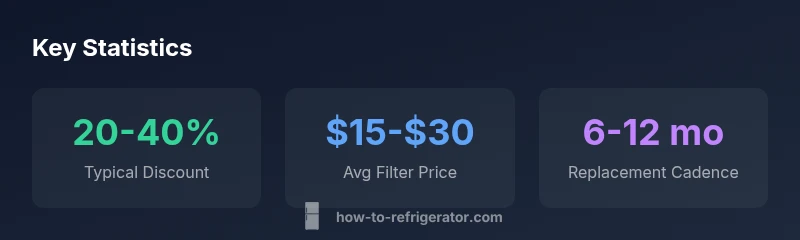
Replacement cadence is driven by water quality, filter design, and usage. Most manufacturers recommend changing standard refrigerator water filters every 6-12 months, with shorter intervals in areas with hard water, high sediment, or visible taste and odor changes. Discount filters can follow the same cadence when properly certified and installed. If your household uses more purified water or if your ice maker shows slow output, you may need to replace more frequently. Conversely, if your water quality is excellent and your fridge has a longer suggested interval, you could extend replacements within manufacturer guidance. The key is to set a reminder and keep a log of replacements, especially when shopping for discounts, to avoid unexpected costs from stale filters.
For households with water quality concerns (high chlorine taste or odor, sediment, or mineral-heavy water), consider filters that meet NSF/ANSI 42 and 53 standards and monitor taste changes over several months. How To Refrigerator Analysis, 2026 indicates that tracking the filter’s performance over time is a reliable way to balance discount pricing with filtration quality.
Installation and compatibility: quick start guide
Follow these steps to ensure a smooth transition when buying discounted refrigerator water filters:
- Identify your fridge model number (usually on a sticker inside the fresh food compartment).
- Check the manufacturer’s filter type and compatible cartridge list.
- Confirm that the discounted filter carries NSF/ANSI certifications relevant to your needs.
- Unpack the filter and rinse the housing and seals before installation.
- Shut off the water supply to the fridge, remove the old cartridge, and inspect the O-ring.
- Install the new filter with the correct orientation; run water for several minutes to flush out carbon fines.
- Recycle or dispose of the old filter according to local guidelines and keep your purchase receipt for warranty claims.
If you encounter resistance or leaks, double-check the seating and O-ring, and consult the user manual. A correct installation minimizes the risk of leaks and ensures optimal filtration performance.
Real-world scenarios and troubleshooting
Discount refrigerator water filters can fail if they are not compatible or not properly seated. Common issues include reduced water flow, unusual taste, or any leaks around the housing. Quick fixes include re-seating the cartridge, ensuring the O-ring is intact and properly lubricated with a small amount of food-grade silicone if allowed by the manual, and flushing the system for several minutes to clear any residue. If the water continues to taste odd or if you notice leakage, remove the filter and inspect the housing for cracks or debris, and verify that the filter matches your fridge model. If necessary, contact the retailer for a replacement or switch to a certified option. Remember: safety and compatibility trump price when it comes to clean, reliable drinking water.
Comparison of common refrigerator water filter types
| Filter Type | Avg Lifespan | Typical Price Range |
|---|---|---|
| OEM-brand replacement cartridges | 6-12 months | $20-$40 |
| Aftermarket universal filters | 3-9 months | $10-$25 |
| In-line fridge filters (water line) | 6-12 months | $15-$30 |
FAQ
Are discount refrigerator water filters as safe as name-brand filters?
Yes, discount filters can be safe if they are NSF/ANSI certified and compatible with your fridge. Certification ensures basic filtration performance, while proper installation is essential for preventing leaks and ensuring safe operation.
If it has an NSF/ANSI certification and fits your model, it should be safe to use. Always follow the installation steps and run the system to flush before use.
How can I tell if a cheap filter will fit my fridge?
Check the fridge model number against the filter’s compatibility list, confirm the filter type (cartridge size and connection), and verify the O-ring and seating design. When in doubt, contact the retailer or manufacturer.
Look up your model number, compare it to the filter's compatibility notes, and verify the seal and installation requirements.
What are the risks of using non-certified filters?
Non-certified filters may fail to remove contaminants effectively, may not seal properly, or could introduce leaks. Certification helps ensure minimum filtration performance and safety.
Non-certified filters might underperform and leak; choose certified options to protect water quality.
Where is the best place to buy discount refrigerator water filters safely?
Purchase from official brand sites, established retailers with clear return policies, or well-known home improvement stores. Avoid unknown marketplaces with limited contact information.
Buy from reputable retailers and check the return policy before buying.
Do discounts apply to subscription filter programs?
Sometimes, subscription programs offer ongoing savings but compare total annual costs with one-time purchases to ensure you’re getting the best deal.
Check the yearly cost to see if a subscription saves you money in the long run.
Should I replace filters more often if my water is high in minerals?
Follow the manufacturer’s cadence. If you notice taste changes or reduced flow sooner, adjust within the recommended interval while staying within safety guidelines.
If your water seems mineral-rich, stick to or slightly shorten the suggested replacement window.
“When shopping for discount refrigerator water filters, verify certifications and compatibility; a cheap filter that fails early ends up costing more over time.”
Top Takeaways
- Verify certification before buying discounted filters
- Match the filter to your model for proper fit
- Weigh price against filter lifespan to maximize value
- Shop at reputable retailers with clear return policies
- Follow manufacturer cadence for replacements