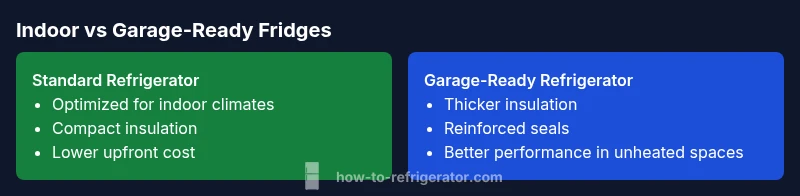
Difference Between Refrigerator and Garage Ready Refrigerator
A comprehensive comparison of indoor refrigerators versus garage-ready models, covering insulation, temperature tolerance, installation needs, energy use, and practical buying guidance for homeowners choosing where to place a fridge.


The difference between refrigerator and garage ready refrigerator centers on environmental tolerance, insulation, and installation requirements. A garage-ready model is designed to withstand colder or more variable garage conditions with thicker insulation, reinforced doors, and protective components for outdoor-like climates. In most homes, a standard indoor refrigerator suffices, while a garage-ready unit offers reliability in unheated spaces and extreme temperatures.
Difference between refrigerator and garage ready refrigerator
According to How To Refrigerator, the difference between refrigerator and garage ready refrigerator centers on environmental tolerance, insulation, and installation requirements. A garage-ready model is designed to withstand colder or more variable garage conditions with thicker insulation, reinforced doors, and protective components for outdoor-like climates. In most homes, a standard indoor refrigerator suffices, while a garage-ready unit offers reliability in unheated spaces and extreme temperatures. This overview sets the stage for practical decision-making that homeowners face when placing a fridge in a garage, workshop, or sun-exposed utility area.
Key design differences that affect performance
Garage-ready refrigerators typically feature thicker insulation, more robust door seals, and external temperature compensation to prevent condensation and ice buildup. They may also include vibration dampening and reinforced hinges to handle location shifts between garage and living areas. While a standard fridge prioritizes energy efficiency and quiet operation in an indoor kitchen, a garage-ready model prioritizes durability and resilience to harsh environments. When evaluating models, compare door gasket quality, insulation thickness, and the presence of protective coatings for the compressor. How To Refrigerator analysis shows that these design choices correlate with fewer temperature-related issues in garages.
Temperature range and climate considerations
Indoor kitchens generally benefit from stable ambient temperatures, often within a comfortable range for electronics and food storage. Garages can swing from cold winters to hot summers depending on your region. A garage-ready refrigerator is engineered to cope with these swings, frequently featuring automatic defrost tied to outdoor sensor readings and compressor protection that prevents short cycling. The practical takeaway: align the model with the space’s typical temperature range to avoid overdesigning a unit that won’t be used to its full potential indoors.
Insulation, seals, and door design
Insulation thickness, door seals, and frame rigidity strongly influence behavior in non-climate-controlled spaces. Garage-ready models often employ heavier foam, more resilient door gaskets, and magnetic seals designed to seal reliably despite temperature fluctuations. This translates to steadier internal cabinet temperatures and reduced moisture on the outside of the door. When shopping, examine door seal effectiveness in low-temperature environments and confirm whether the gasket is rated for damp or unheated spaces. The extra reinforcement reduces the probability of energy loss and frost-related issues.
Electrical and installation requirements
Indoor refrigerators typically plug into a standard 120V kitchen outlet with minimal vibration control. Garage-ready units may still use 120V but often benefit from a dedicated circuit or a GFCI-protected outlet, especially in damp environments. Ensure adequate clearance around the condenser coils and a stable mounting surface. If the garage experiences outages or surges, consider a surge-protected outlet. Proper placement—away from direct sun and with space for airflow—helps sustain performance and longevity.
Cost, value, and practical decision framework
Premium garage-ready refrigerators cost more upfront due to insulation, seals, and rugged components. However, the value comes from fewer spoilage incidents and longer compressor life when the unit faces temperature swings. How To Refrigerator analysis shows that the incremental cost is often justified in unheated spaces or structures with frequent temperature fluctuations. Homeowners should weigh the extra capital against space usage, climate, and how often the fridge will be accessed. If a fridge will live primarily in a garage or workshop, the added durability can translate into real long-term savings.
Maintenance tips for garage-use fridges
Clean coils regularly and inspect door seals for wear at least twice a year. In garages, position the unit away from direct sunlight and ensure adequate clearance for airflow. Use a thermostat probe to monitor internal temperature and set it to a safe range for your typical ambient temperature. If you notice frost buildup or condensation inside, check the defrost system and seal integrity. Regular proactive maintenance preserves efficiency and prevents early component wear.
Common myths and misconceptions
Some homeowners assume garage-ready fridges are always more expensive to run. In reality, efficiency depends on how well the unit is matched to the space and how often it is opened. Others think you can use any fridge outdoors; exposure to humidity and temperature can shorten the lifespan. The goal is to pair the right model with the location to maximize reliability and minimize energy waste.
Practical decision framework for choosing between models
Begin by assessing your space: is the garage heated or unheated? What temperatures are typical across seasons? Check the manufacturer’s specifications for operating ranges, defrost type, and door seals. Then estimate total cost of ownership, including potential energy use and replacement frequency. If in doubt, consult a How To Refrigerator guide to confirm your choice aligns with your environment. A disciplined approach—matching space conditions to product capabilities—optimizes performance and lifecycle costs.
Case studies and real-world scenarios
Case A: A homeowner in a temperate climate uses a standard refrigerator in an attached garage year-round. During cold snaps, the freezer occasionally experiences frost buildup, and the owner notices occasional cycling delays. Switching to a garage-ready model eliminates the frost issues and stabilizes the interior temperatures, improving food safety and reducing alarmingly frequent temperature fluctuations. Case B: In a hot, uninsulated garage, a standard refrigerator shows increased compressor activity during summer, leading to higher energy use. A garage-ready unit with enhanced insulation and a robust condensation system maintains consistent temperatures, delivering better reliability in extreme heat. These scenarios illustrate practical outcomes homeowners experience after choosing models aligned with space conditions.
Comparison
| Feature | Standard Refrigerator | Garage-Ready Refrigerator |
|---|---|---|
| Temperature Tolerance | Indoor climate optimization | Wide operating range for unheated spaces |
| Insulation & Seals | Standard insulation, typical gaskets | Thicker insulation, reinforced seals, condensation control |
| Electrical Requirements | Standard 120V circuit | Dedicated outlet often recommended; robust protection |
| Installation Location | Indoor kitchen | Garage or unheated space |
| Energy Efficiency | Typically high efficiency in indoor units | Durability prioritized in garage-ready units |
| Reliability in Cold | Moderate resilience to temperature swings | Enhanced resilience to wide swings including freezing |
| Initial Cost | Lower upfront cost | Higher upfront cost for rugged design |
Strengths
- Better reliability in garages and unheated spaces
- Prevents spoilage from temperature swings
- Durable construction and longer compressor life in harsh environments
- Seamless integration with workshop or utility spaces
Cons
- Higher upfront cost compared to standard models
- Requires careful space assessment and possibly dedicated electrical setup
- Limited availability in some regions or models
- Possible overkill for strictly indoor usage
Garage-ready refrigeration is the better choice for unheated, temperature-variable spaces; use a standard refrigerator for climate-controlled indoor kitchens.
If your installation space experiences temperature swings or moisture, a garage-ready fridge reduces risk of spoilage and wear. For stable indoor kitchens, a standard refrigerator remains the most cost-effective and energy-efficient option.
FAQ
What is a garage-ready refrigerator, and where should I use it?
A garage-ready refrigerator is designed to operate reliably in unheated or temperature-variable spaces, with enhanced insulation and protective features. It helps prevent spoilage and mechanical failures when placed in garages or sheds.
A garage-ready fridge works better in garages or cold spaces because it's built for temperature swings.
Can I convert a standard fridge for garage use?
Conversion is not generally recommended; garage conditions may require different insulation and seals. If you must, consult the manufacturer’s guidance and consider a model designed for external spaces.
Converting a standard fridge isn’t usually advised; garage-ready designs are built for those spaces.
Are garage-ready models more energy efficient than standard fridges?
Energy efficiency varies by model and capacity. Garage-ready units prioritize resilience to temperature swings and may use features that trade some efficiency for reliability in extreme environments.
Energy use depends on the model; garage-ready may be less efficient but more reliable in harsh spaces.
What temperatures can a garage-ready fridge handle?
Garage-ready fridges are designed to operate across a wider ambient temperature range than indoor models. Check the manufacturer specs for the exact operating range.
They handle wider temperature swings—check your model’s specs.
Do I need special outlets for a garage fridge?
Some garages benefit from a dedicated circuit or GFCI outlets, especially in damp environments. Always follow local electrical codes and manufacturer recommendations.
A dedicated or protected outlet is often wise for garage setups.
What installation considerations matter most for garage use?
Ensure proper clearance for airflow, protect against humidity, and avoid placing the fridge where heat sources or direct sun can affect performance. A stable surface reduces vibration and noise.
Keep it in a spot with good airflow, away from heat and sun.
Top Takeaways
- Assess space temperature stability before buying
- Choose insulation and seals appropriate for unheated spaces
- Factor installation and electrical needs into the total cost
- Garage-ready units excel in garages and extreme environments
- Indoor kitchens benefit most from standard, energy-efficient models